Get Full Government Meeting Transcripts, Videos, & Alerts Forever!
Get email alerts on the Ab 744 Implementation topic
No spam. Unsubscribe anytime.
Transportation Commission outlines options to implement AB 744 data program
Summary
At a Dec. 17 webinar, Transportation Commission staff reviewed AB 744's requirements, outreach results and two implementation paths: a grant program letting agencies procure tools or a centralized procurement with Caltrans to provide statewide access. Staff sought more agency input and set a timeline toward a 2025 proposal.
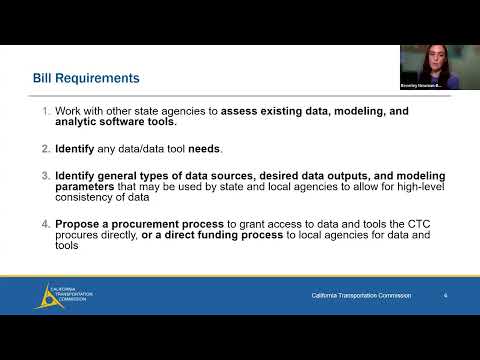
The Transportation Commission on Dec. 17 held a virtual workshop to kick off implementation of Assembly Bill 744, which directs the commission to assess transportation data and modeling tools, identify common data sources and outputs, and propose a process to provide local and regional agencies access to modeling and analytics tools.
Commission staff said they are weighing two options required under AB 744: a direct funding program that would let agencies apply for grants to buy tools that suit their needs, or a centralized procurement (in partnership with Caltrans) that would procure platforms and grant access through a statewide data hub. "We are still looking at both of these options," said Beverly Newman Burkhard, who has been leading the AB 744 effort and presented the workshop. "We will...decide which route to take based on which option is least prohibitive for us."
Why it matters: staff told stakeholders that standardizing data outputs and improving access to modeling tools could help smaller and rural agencies compete for funding and improve statewide consistency in planning and reporting. But the inventory and stakeholder surveys also showed substantial barriers: many agencies lack funds and technical capacity to operate high-cost data platforms.
What the engagement found: staff reported meetings with roughly 15 agencies and said Caltrans's inventory drew responses from about 18 MPOs. The Caltrans inventory and other engagement surfaced wide cost ranges: transportation modeling subscriptions were reported in the inventory at about $1,500 to $800,000, and big-data/analytic subscriptions at about $48,000 to more than $1.2 million. Staff said those figures illustrate the affordability gap for smaller agencies and the need for technical assistance and best-practice sharing.
On data and privacy: Christian Forbey, deputy executive director of the California Electric Transportation Coalition, urged the commission to consider privacy and data-aggregation approaches for utility planning, noting utilities often seek DMV or registration data that can be sensitive and expensive to notify customers about. "One of the things you might want to consider are privacy issues," Forbey said, adding that aggregating DMV data to transformer- or circuit-level can preserve utility planning value while reducing personal exposure.
Staff follow-up and transparency: participants asked about sharing survey results. Beverly Newman Burkhard said the commission will post the workshop slides and a summary of CTC survey results on the program page and invited agencies to join a distribution list for the AB 744 transportation data program. Katie Murphy of Caltrans said she would check with colleagues before promising release of the full Caltrans survey data.
Key deadlines and next steps: staff outlined a near-term schedule to produce a legislative proposal. They said they expect to update commissioners in January, post draft proposals and hold a second workshop in February 2025, provide additional commissioner updates in March/April, target commission adoption in June 2025, and submit proposals to the legislature in July 2025. Staff also committed to wider outreach, notably to Central Valley agencies, and to follow up on whether any tools measure accessibility for people with disabilities.
No formal votes were taken at the workshop. Staff asked stakeholders for feedback on the evolving tool list and welcomed additional meetings and survey responses. For more information or to join the program distribution list, staff displayed contact information and a program webpage; they also said slides and a recording would be posted after the workshop.