Get Full Government Meeting Transcripts, Videos, & Alerts Forever!
Get email alerts on the Competition Credit Cards topic
No spam. Unsubscribe anytime.
Senators probe airlines’ credit‑card partnerships, hub dominance and effects on competition
Summary
Lawmakers questioned carriers about large co‑branded credit‑card revenues, hub and slot dominance, and how rewards programs and bank partnerships can entrench legacy carriers and limit competition; witnesses gave revenue estimates and urged a closer look at market power.
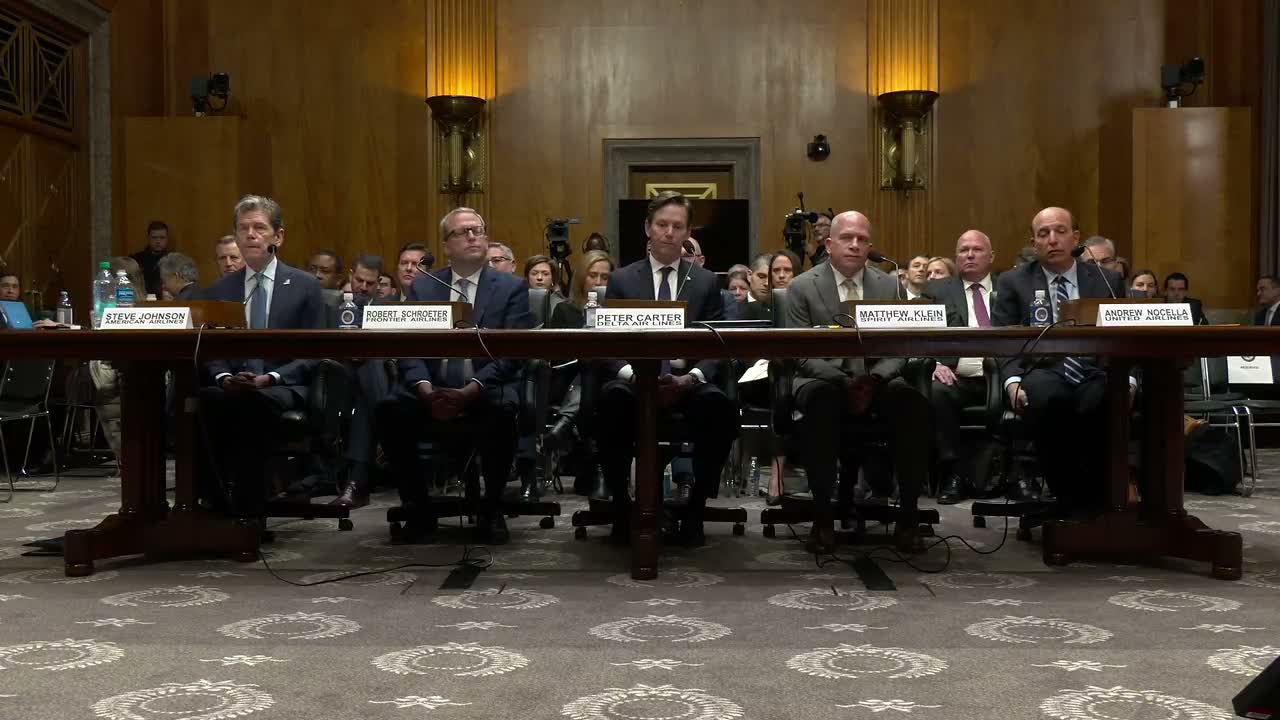
WASHINGTON — Senators used testimony on Dec. 4 to spotlight how loyalty and co‑branded credit‑card programs and airport hub control can concentrate market power and blunt competition.
Senator Roger Marshall asked witnesses about revenue from rewards programs. Andrew Nocella (United) said the airline takes in more than $3,000,000,000 in revenue from its rewards program; Steven Johnson (American) said American’s revenue from rewards was about $5,000,000,000 in 2023. Senators framed those payments and bank partnerships as a source of durable advantage that can let legacy carriers operate with lower apparent operating profits while shifting revenue to non‑airline channels.
Witnesses described competition barriers: Spirit’s Matt Klein pointed to gate and slot access and the difficulty of attaining critical mass at major hubs, and to credit‑card relationships that deepen customer loyalty. Committee members pointed to Department of Justice actions (for example, the DOJ complaint in the JetBlue‑Spirit matter) as evidence of competitive concerns and said consolidation since 2008 left a small set of airlines controlling roughly 70% of domestic traffic.
Carriers responded that rewards‑program revenue is part of a broader set of revenues and costs and that those programs also deliver consumer benefits; witnesses said the figures discussed are revenue, not profit, and cited investments in product and service improvements.
The committee asked the Department of Transportation and Department of Justice to review competitive concerns raised in the investigation and to consider whether further regulatory or enforcement action is needed.