Get Full Government Meeting Transcripts, Videos, & Alerts Forever!
Get email alerts on the Procurement It Award Recommendations topic
No spam. Unsubscribe anytime.
Statewide IT procurement team urges clearer award-recommendations, warns 'words matter' after bid protests
Summary
State procurement trainers advised agencies to use three standardized award-recommendation templates (IFB, RFQ, RFP), document why vendors were responsive or not, and include tight narratives translating evaluation scores into strengths/weaknesses to reduce protest risk.
Andrea, a member of the State Information Technology Procurement (SITP) team, led a training session on improving statewide award-recommendation templates, telling attendees the agency now uses three distinct forms — for IFBs, RFQs and an extensive RFP award-recommendation — and emphasizing better documentation to withstand protests.
Why it matters: Andrea said clearer, standardized award recommendations give reviewers and outside readers a transparent account of why a vendor was selected and make protests less likely. She told participants to prepare the award recommendation as the evaluation proceeds rather than waiting until the end of the review cycle.
Key recommendations and examples
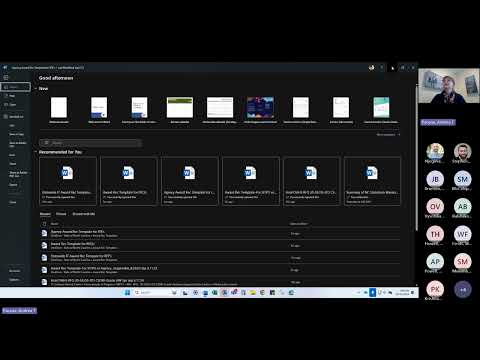
- Templates: Andrea walked through brief RFQ and IFB templates and a long RFP template that consolidates comments from statewide DOJ legal. She said the RFQ form is short because the sole-source justification is usually already documented, while the RFP form must be long and precise.
- Match evaluation criteria to the posted RFP: Andrea recounted a past protest in which evaluators "morphed" the published criteria and noted this mismatch contributed to legal challenges. She said evaluators must "go back and confirm" that the criteria used in scoring exactly match what was posted in the solicitation.
- Responsiveness checklist: Draft templates include a responsiveness matrix for purchasing agents to document whether each offer contained required items. Andrea said the purchasing agent should determine responsiveness first; nonresponsive vendors are removed from the pool sent to the evaluation team.
- Explain strengths and weaknesses: Drawing on guidance from colleagues, Andrea warned that simply listing a strength or weakness is insufficient: "You need to say what the strength or weaknesses is, but then you have to say why that's a strength or weakness in relation to this particular procurement." Translating numeric scores into clear narrative reasoning helps reviewers and later protest defenders understand decisions.
- Wording and the "death match" case: Kenneth, who described a recent procurement the presenters called the "death match," said problematic RFP wording requiring highly sensitive security documents at time of submission made all vendors nonresponsive and forced a cancellation and rebid. "Words matter," he said, explaining that the team had to rework solicitation language to restore competition.
- Post-award document requirements and timing: Andrea said the team will revise templates to require a Vendor Risk Assessment Report (VRAR) and SOC 2 reports from the selected top vendor, but collect them after award notification. She noted the session did not specify the exact number of days vendors would have to deliver those documents.
- Best-practice documentation: Presenters urged having a designated scribe on evaluation teams to record discussion, strengths and weaknesses, demo outcomes (for finalists), BAFOs and negotiation topics so the award recommendation can tie the narrative together concisely.
Legal context and protest risk
Andrea cited a North Carolina Supreme Court ruling to underline that clarifications after submission cannot be used to cure material deficiencies: "Clarifications are not meant to collect material deficiencies," she said. Because of that guidance, the presenters said agencies should be strict about what must be submitted with an offer and careful about using clarifications to gather missing required materials.
Questions from DOJ legal and others focused on how removing nonresponsive vendors affects later evaluations. Alicia of statewide DOJ legal asked whether declaring a vendor nonresponsive effectively removes them from later strengths/weaknesses comparisons; speakers agreed the nonresponsive offer should be documented and excluded from the evaluation pool, with the reasons for nonresponsiveness clearly recorded for protest defense.
Closing and next steps
Andrea closed by urging procurement staff to prepare award recommendations concurrently with evaluations, assemble supporting documents in procurement files or SharePoint, and run drafts by statewide DOJ legal before final approval. The team offered to share a responsiveness checklist and an evaluation kickoff presentation to help agencies implement the best practices discussed.
The training ended with a reminder that careful wording, thorough documentation and clear rationales reduce legal exposure and preserve competition.