Get Full Government Meeting Transcripts, Videos, & Alerts Forever!
Get email alerts on the 14 Dioxane topic
No spam. Unsubscribe anytime.
DEQ report finds elevated 1,4‑dioxane exposure in Cape Fear basin; SAB to review scientific defensibility
Summary
DEQ presented a legislatively directed human health risk assessment for 1,4‑dioxane showing higher concentrations in the Cape Fear River Basin and concluded North Carolina exposures may be up to twice the national drinking‑water average; the Science Advisory Board agreed to review the report’s methods and findings and to provide formal feedback.
The Department of Environmental Quality presented a human health cancer risk assessment for 1,4‑dioxane that it prepared under legislative direction. DEQ outlined an exposure assessment indicating most elevated environmental occurrences and higher drinking‑water concentrations are concentrated in the Cape Fear River Basin. The report used EPA IRIS hazard values and concluded that, based on available data, North Carolinians in affected areas experienced roughly half the protection the rest of the nation had during the UCMR‑3 sampling period.
DEQ summarized key technical elements: maps comparing pre‑regulatory and post‑regulatory occurrence data (2014–2021 versus 2022–early 2024), a comparison to the national UCMR‑3 mean concentration (0.45 µg/L), and risk‑characterization using the EPA IRIS cancer slope factor. Frannie Nielsen (DEQ) explained that regulatory actions and voluntary steps by some dischargers reduced environmental and drinking‑water concentrations in many locations but that some Cape Fear River Basin systems remain at higher levels.
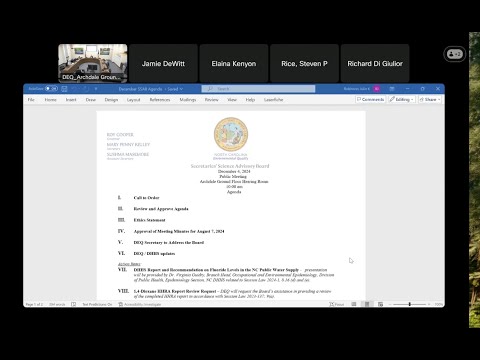
Board role and charge: DEQ asked the board to review whether the report’s approach and conclusions are scientifically defensible and to provide formal feedback. Board members suggested clarifying what is meant by “scientifically defensible” (e.g., literature scope, exposure binning, selection of benchmark values) and recommended that any future summary highlight watershed‑specific results rather than statewide averages because the Cape Fear basin drives much of the state signal.
Next steps: The board agreed to provide peer review‑style comments; staff noted the report is final and that some additional analytical breakdowns (for example, watershed‑level analyses) could be incorporated in forthcoming peer‑review manuscripts rather than in the final legislative report.
Ending note: DEQ said the IRIS slope factor and exposure results are being applied in permitting and cleanup contexts and that programmatic actions (including possible effluent limits and source‑reduction strategies) are still evolving.