Enterprise Technology Services asks Appropriations for $15.7M to shore up cybersecurity, ADA access and IT transitions
Loading...
Summary
Enterprise Technology Services told the Appropriations Committee it needs about $15.7 million in exception requests to replace aging security infrastructure, fund ADA website remediation, realign positions tied to a retiring mainframe, and expand centralized services such as citizen authentication and GIS data.
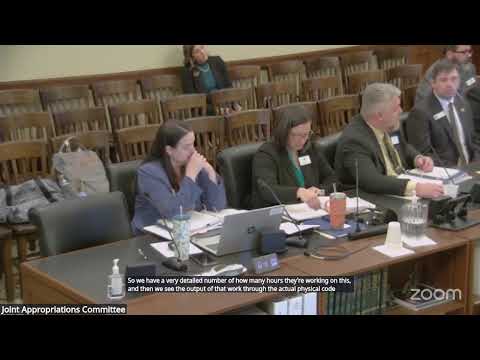
Enterprise Technology Services (ETS) requested roughly $15.7 million in exception funding on the Appropriations Committee floor, telling lawmakers the money is needed to keep state systems secure and reliable as agencies migrate from legacy platforms.
The agency’s director, Jeff Klines, and CFO Kristen Burkhart outlined a package that includes cybersecurity hardware and tooling, a $5.26 million multi‑year plan to remediate citizen‑facing websites for ADA accessibility, and several accounting and position realignments driven by the planned retirement of a legacy mainframe. "Our mission," Klines said, "is excellence through service," a theme he said undergirds the budget requests.
Why it matters: ETS provides core digital infrastructure and administrative IT services used across state government — from the citizens who renew driver’s licenses to agencies that send emergency text alerts. Committee members pressed ETS for details on long‑term sustainability, cost allocation and vendor compliance before votes on floor amendments.
What ETS asked for and why - Position realignment (Division 1000): ETS asked for $1,428,009 in general fund to move six positions away from legacy mainframe funding into the general fund and correct where salaries are charged. Klines said the mainframe is scheduled to be retired in April and that several staff with roles tied to it will be reallocated to other network and monitoring duties. - Cybersecurity and infrastructure: The agency requested $743,524 to replace aging application firewalls and load‑balancing equipment (end of life expected January 2027) and additional requests to expand centralized compliance tooling and unified endpoint management ($360,000 and $330,322 respectively) to improve automated monitoring, patching and vulnerability reduction. - ADA digital accessibility: ETS proposed $5,261,934 in general funds to assess and remediate state websites and applications to meet federal ADA obligations under new guidance. Burkhart said ETS estimates a 5–6 year remediation program with ongoing monitoring to keep sites compliant. - Centralized citizen authentication: ETS requested $620,342 to fund a login platform (login.gov) the agency is piloting with WYDOT’s MAX service. ETS described the cost as consumption‑based and said the appropriation represents an upper bound if statewide adoption grows rapidly. - Licensing, archives and asset management: A $197,877 request would continue Google Workspace licensing and automation; ETS staff warned archive licenses and inactive accounts drive costs. ETS also sought funding and authority for cloud services ($1,497,475 internal service fund authority) and centralized GIS licenses (Esri) to standardize and reduce administrative burden.
Committee questions and follow‑ups Lawmakers repeatedly asked for more precise cost comparisons, timelines and external dependencies. Key follow‑ups requested by the committee included: a detailed Google vs. Microsoft licensing cost report for floor debate; an audit schedule and scope from the Department of Audit (ETS said planning is complete and the audit will begin in January, with an estimated 2–3 month fieldwork window); confirmation that the PCI payment processor complies with recently enacted state law; and technical briefings on how a statewide GIS data standard would interact with county systems and NextGen 911.
On cost allocation, Director Hibbert of the state budget department explained that moving some ETS services from the 400 series (agency billing) to the general fund will place those costs into the statewide cost allocation process, which then charges special revenue and federal funds their share; he said the shift is largely an accounting movement, not an increase in total statewide cost.
Claims, risk and legal context ETS officials described the current cybersecurity environment as evolving and said legacy systems and shrinking talent pools (notably mainframe expertise) are driving many requests. ETS also told lawmakers it had consulted the attorney general’s office about ADA legal risk and was advised to document remediation plans and prioritize citizen‑facing service functions to reduce litigation exposure.
Quotes "Our mission ... is excellence through service," Director Jeff Klines said as he framed ETS’s role. "The cybersecurity threat landscape continues to evolve," he added when explaining why upgrades are needed. CFO Kristen Burkhart described the ADA request and said, "This request ensures the state meets its responsibility to provide equal access to online services."
What happens next No formal votes or motions were recorded in this session. ETS said it will email the committee the Department of Audit’s anticipated timeline, prepare a detailed Google/Microsoft cost report for the floor, and follow up on GIS technical and PCI compliance questions. The committee recessed for lunch and scheduled TRP and remaining ETS items for the afternoon session.
Reporting note: Quotes and dollar figures in this piece are drawn from ETS’s presentation to the Appropriations Committee and committee Q&A.