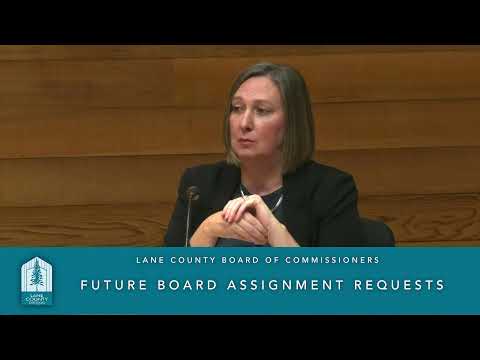
Lane County approves procedural fourth reading for ordinance 2507; fifth reading set for Dec. 16
Loading...
Summary
County staff said proposed amendments to riparian and shoreland rules are required to comply with state law; commissioners debated whether driveway access and on-site sanitation should be excluded from the clear-and-objective housing pathway and voted 5-0 to approve the fourth reading and return for a fifth reading on Dec. 16.
Lane County commissioners on the continuation of their meeting approved a procedural fourth reading of Ordinance 2507 — amendments to Lane Code Chapter 16 to create a clear-and-objective permitting pathway for housing in zones that include riparian and shoreland overlays — and set a fifth reading for Dec. 16, 2025.
Planning staff told the board they reopened the record after the Nov. 4 meeting, held a stakeholder session on Nov. 17, and recommended minor clarifying edits. "We maintain that the proposed amendments are necessary to comply with state law," staff said, noting they had asked stakeholders to submit specific written comments in advance but received few details beyond two recurring issues.
The most contested point among stakeholders and some commissioners was whether accessory development — specifically vehicle access (driveways) and on-site wastewater or septic systems — should be treated as "housing" for the purpose of the clear-and-objective pathway. Staff recommended excluding accessory structures, vehicle access and sanitation systems from the housing definition to align with the Oregon Court of Appeals decision in Roberts v. City of Cannon Beach and to preserve the county’s ability to apply discretionary standards that address life-and-safety concerns.
Several commissioners pressed staff and legal counsel for clarification about the Roberts decision and how broadly its reasoning should apply. Commissioner Farr said he needed more time to be confident the ordinance would remove barriers to housing as intended, especially in urban transition areas, and asked for one-on-one follow-up with staff. Other commissioners said the record had been open long enough and that staff had proposed only one substantive language change.
Commissioner Trigger moved to approve the fourth reading and to return the ordinance for a fifth reading on Dec. 16 to incorporate the staff memo language and county counsel's Goal 5 memo into the findings; Commissioner Buck seconded. Vice Chair, Chair Lovell, Commissioner Farr and others signaled support. The motion passed on a voice vote, 5-0.
Next steps: the board will receive the revised ordinance language at the fifth reading on Dec. 16, after which the board may take final action. Staff also offered to give stakeholders an additional, approximately one-hour meeting before Dec. 16 as a courtesy to attempt to address remaining questions.
Authority and context: staff referenced Oregon Revised Statutes §197.400 as a state law driver for the code updates and cited the Roberts v. City of Cannon Beach appellate decision as a legal basis for treating certain ancillary development separately from the definition of housing. The board did not adopt final ordinance text at this session; the vote approved a procedural step to continue deliberations.