Get email alerts on the Housing Framework topic
No spam. Unsubscribe anytime.
Kalamazoo County presents draft housing framework, pledges implementation plan and community engagement
Summary
County housing director presented a high‑level draft framework to coordinate homelessness response through affordable homeownership, citing $33 million allocated from the county housing millage and 1,492 funded units; commissioners pressed for more detail on township inclusion, low‑income benchmarks and HMIS integration before implementation planning.
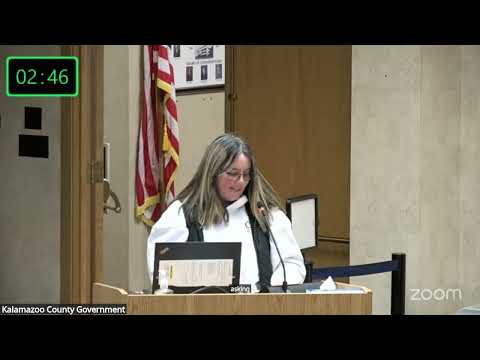
Mary Balkema, Kalamazoo County housing director, presented a draft county housing framework on Nov. 18 that she described as “a blueprint for aligning resources, partners, and strategies across a full housing continuum from emergency shelter to affordable homeownership.” The high‑level document, sent to commissioners in advance, is intended as a working framework to guide a later, data‑driven implementation plan with measurable outcomes and broad community engagement.
Balkema told the board the county has allocated more than $33,000,000 across four funding rounds from the housing millage approved in 2020 and has supported about 1,492 housing units, about 74% of which are under construction or occupied. The county’s proposed organizational structure would create two divisions within county housing — a supportive housing division and a housing development authority — and rely on strategic partnerships with the county land bank and the Continuum of Care to amplify existing capacity.
The framework identifies priorities ranging from emergency shelter and intake facilities to an accelerator fund for housing development, a proposed county voucher program, and expanded direct housing assistance (emergency rental assistance, down‑payment help and affordable mortgage products). Balkema said the county does not intend to become a direct service provider but to fund and coordinate work by community partners and nonprofits.
Commissioners broadly praised the high‑level goals but pressed staff for more detail before the county moves to implementation. Commissioner Gisler asked whether townships and villages — which together account for roughly half the county population — have been included in outreach and requested more deliberate engagement with township supervisors. Balkema said township engagement is “still in process” and that staff have met with supervisors and plan further presentations.
Several commissioners urged stronger commitments for the lowest income brackets. Commissioner Ray asked whether the proposed county database would replace or integrate with HMIS (the federally required Homeless Management Information System). Staff replied the database would need to feed into HMIS for federal reporting while also accommodating broader local data needs. Commissioner Morales and others pressed the county to name strategies for households at 0–50% AMI and to ensure programming addresses people who fall into the 30–50% and middle‑income bands that often get overlooked.
Balkema said the draft will be converted into a strategic and implementation plan with timelines and measurable benchmarks and will return to the board with an interlocal agreement for consideration in December. She said the next phase will include asset mapping, stakeholder engagement and a contracted strategic plan to add the granular details commissioners requested.
The board signaled support for the general approach while reserving judgment on specifics until the implementation plan is shared.
AI generated
The text on this page is AI generated. Summaries, highlights, analysis, and video transcripts are all produced from the original source material.
AI can make mistakes, so if you spot one, and we will fix it for everyone.
Note: the source content is unaltered by us. Any content source we link to, be it a video, an audio recording, or a document, is presented exactly as its publisher released it. That publisher is usually a government body, sometimes an individual official or another organisation.