Get Full Government Meeting Transcripts, Videos, & Alerts Forever!
Get email alerts on the Forest Stewardship topic
No spam. Unsubscribe anytime.
DeWitt board tables updated forest stewardship plan after consultant presentation and teacher concerns
Summary
After a detailed presentation by consultant James Gray on a proposed forest stewardship, restoration and education plan, the DeWitt Public Schools Board of Education voted to table the proposal following concerns from teachers about timber-harvest language and stakeholder notification.
James Gray, a consultant with Natural Capital Forestry, presented an updated forest stewardship, restoration and education plan to the DeWitt Public Schools Board of Education and asked the board to approve it as the district’s guiding document for roughly the next decade. The board instead voted to table the plan until the next meeting after public comment raised concerns about timber-harvest provisions and stakeholder notification.
Gray said the plan updates a document put in place about 11 years ago and reflects a shift from a timber-focused approach to a more ecological model that emphasizes biodiversity, restoration and youth engagement. "I titled it a forest stewardship restoration and education plan," Gray said, describing recommendations to restore oak and hickory regeneration, manage invasive species such as black locust and autumn olive, and use parts of the forest for hands-on education, volunteer projects and carbon-sequestration monitoring with local schools and colleges.
Why it matters: The plan would guide management of school-owned forest parcels including the DeWitt Nature Center and could authorize selective timber removals intended to improve forest structure and generate revenue for restoration and education efforts. The proposal also outlines partnerships, volunteer networks and possible revenue sources including timber sales and carbon credits.
Gray told the board the plan proposes strategic, limited harvests of lower-quality trees while protecting the largest canopy trees to create growing space for future oaks and other desired species. He also recommended benchmarking biodiversity and involving students in long-term monitoring and restoration work, and described pilot projects with local schools and colleges to measure carbon sequestration and provide career-focused learning experiences.
Brian Byers, speaking as a teacher representative, urged caution and asked the board to delay approval if the plan would "lock us into harvesting the timber." Byers cited a past episode that drew wide attention when harvesting proceeded without early stakeholder input, and said a prior oversight damaged the cross-country course start area and required reseeding and releveling. "If the plan is locking us into harvesting the timber, I think we're remiss not having the presentation of where we're harvesting the timber... If we are getting locked in, I think we should table this until other stakeholders get a chance to look at the plan," Byers said.
Rob (staff member) responded that the plan's language had been formatted to make recommendations clearer and that "these are just recommendations. It was not... locked in from a district's perspective," and noted that consultant James Gray participated throughout the development process.
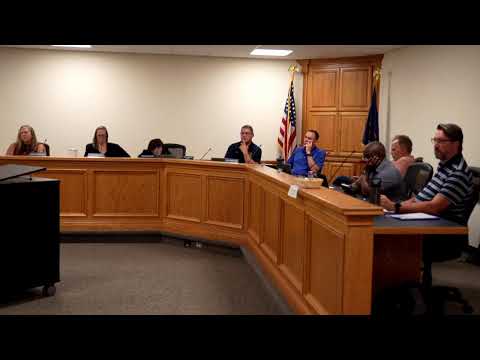
Following public comment, a board member moved to table the plan. The motion was seconded and carried on a voice vote; the board "chose to table this instead of approve it today until next meeting." The board did not take a formal recorded roll-call tally on the motion in the transcript; mover and seconder were not identified in the record.
The plan is notable for combining ecological restoration goals with education and potential revenue streams; Gray suggested volunteer coordination through the Friends of DeWitt Nature Center, student-led seed collection and planting programs, partnerships for carbon accounting with Alma College and potential certifications through institutions such as MSU Kellogg Biological Station. The consultant recommended adaptive management with regular updates rather than a fixed, mandatory list of actions.
The board did not set a specific date or conditions for bringing the plan back for final approval at the time of the vote.