Get Full Government Meeting Transcripts, Videos, & Alerts Forever!
Get email alerts on the Public Safety topic
No spam. Unsubscribe anytime.
Police present budget overview, cite K‑9 seizures, rising calls and expansion of city camera system
Summary
Presenters told the council the police budget comprises three sections and represents roughly 39–40% of the city budget; they highlighted a re‑established K‑9 unit, nearly 300 cameras being deployed, rising calls for service (about 54,000 year‑to‑date), and continued reliance on grants to hold the department under 40% of the budget.
Speaker 3 presented the police department budget and operations, saying the department is organized into three sections — the police force, traffic court and police civilians — and that the department accounts for roughly '39.5%' of the city budget. Speaker 3 said the department acquired seven new vehicles paid for by grants and is trying to keep its share of the budget 'under 40%.'
The presentation underscored rising demand: Speaker 3 said calls for service were "currently, we're in the 54,000" and projected the year would reach about 63,000 calls by Dec. 31. Speaker 3 attributed part of the increase to stronger community trust and to more reports of fraud and indecent‑touching incidents, particularly scams targeting older residents.
Speaker 7 described early operations of a real‑time crime center and camera network, saying the city has "roughly about 200 to 300 cameras" deployed and is adding license‑plate readers and feeds from partner agencies. Speaker 7 said the system is intended to help detectives backtrack video during investigations and to provide live situational awareness on major incidents; the speaker cautioned cameras are not monitored 24/7 but can be referenced when officers respond to calls for service.
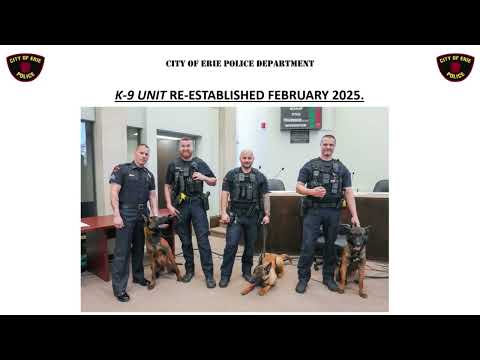
The presentation highlighted programmatic investments. Speaker 3 said the K‑9 unit (with dogs Beau, Atlas and Deacon) seized firearms and narcotics and produced about $18,000 in recoveries tied to those operations. The department also described grant‑funded positions (32 grant‑funded positions cited for 2025) and a remodeling of central operations, which presenters said had asbestos removed and facility upgrades underway.
Speakers noted public‑safety context and outcomes. Speaker 3 cited local homicide clearance rates above the national average and attributed reductions in gang‑related violence to multiagency work and federal prosecutions. The presentation closed with a note that current funding and grants keep staffing near 194 officers through 2029 but that future retirements and attrition could create pressure to sustain that level.
The presentation generated brief questions from council participants about vehicle accidents involving new units, camera placement near sidewalks, and data retention; presenters said some crash costs were covered by grants and that storage and archiver servers govern retention times. No formal action or vote was recorded on the police budget during this session.