Get Full Government Meeting Transcripts, Videos, & Alerts Forever!
Get email alerts on the Bill 36 0105 topic
No spam. Unsubscribe anytime.
Senate committee advances ban on many hemp‑derived intoxicants as DOH, OCR and AG back amended measure
Summary
After testimony from the Department of Health, Office of Cannabis Regulation and the Attorney General, the Senate committee voted 6–0 (1 absent) to advance an amended bill that would prohibit THCA and chemically derived delta‑6/8/10 THC products and align territory rules with new federal limits.
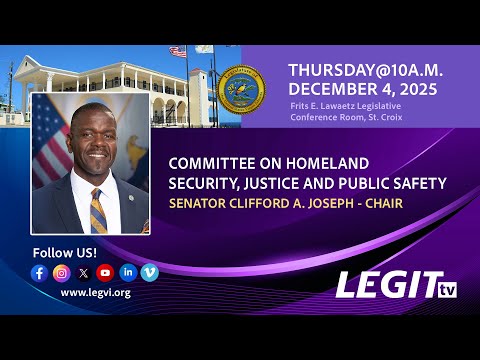
ST. CROIX — The Senate Committee on Homeland Security on Dec. 4 voted to advance an amended territorial bill (36‑0105) that would prohibit possession, sale and manufacture of certain hemp‑derived intoxicants, including tetrahydrocannabinolic acid (THCA) and delta‑6, delta‑8 and delta‑10 THC products.
The Department of Health, Office of Cannabis Regulation (OCR) and the Attorney General each testified in support of the bill as amended and urged technical changes to reflect recent federal action that redefines hemp and sets a per‑container total‑THC limit. "This measure provides a decisive preventive measure," Commissioner Justa Encarnacion told the committee, highlighting CDC and FDA warnings about poisoning, hallucinations and other adverse events tied to unregulated cannabinoid consumables.
OCR Executive Director Joanne Moorehead told the committee the new federal agriculture and FDA appropriations language (enacted in November) establishes a strict 0.4‑milligram total‑THC‑per‑container threshold and excludes chemically converted cannabinoids from the federal hemp definition. Moorehead said the Office supports the bill’s intent but cautioned that enforcement authority should be consolidated under OCR rather than split across agencies. "A unified regulatory structure that brings all intoxicating cannabinoid products under OCR’s authority will provide consistency and enforceability," she said.
The Department of Licensing and Consumer Affairs echoed the call to align territorial rules with the federal total‑THC framework, recommended adopting the federal calculation method by regulation, and urged a 120‑day rulemaking window (rather than 90 days) so agencies can coordinate testing, packaging and retailer licensing.
The Attorney General, Gordon Wray, told senators that while the new federal changes will take effect in 2026 and could overlap with local law, the amended bill helps close immediate gaps and gives law enforcement clear authority. He noted the amended language provides civil penalties (the amendment increases fines and permit‑revocation authority for repeat offenders).
After public testimony and technical Q&A, the committee approved amendment 36‑565 and voted to forward the amended bill to Rules for further consideration. Clerk roll call showed six senators voted yes and one was absent. The measure’s next stops are Rules and then the full Senate; OCR and DLCA said they will draft regulations and interagency memoranda to coordinate inspections, testing and seizures.
What’s next: The amendment requires OCR to write implementing rules; DLCA and DOH recommended explicit total‑THC calculations, child‑resistant packaging, ISO‑accredited testing and retailer licensing. Committee members urged rapid implementation and tighter enforcement during the rulemaking period to reduce public‑health risk.
Vote: Committee recorded a favorable vote to forward Bill 36‑0105 as amended to Rules (6 yes, 1 absent).