
El Segundo council narrows rules for Candy Cane Lane after residents cite safety, trash and access problems
Get AI-powered insights, summaries, and transcripts
Subscribe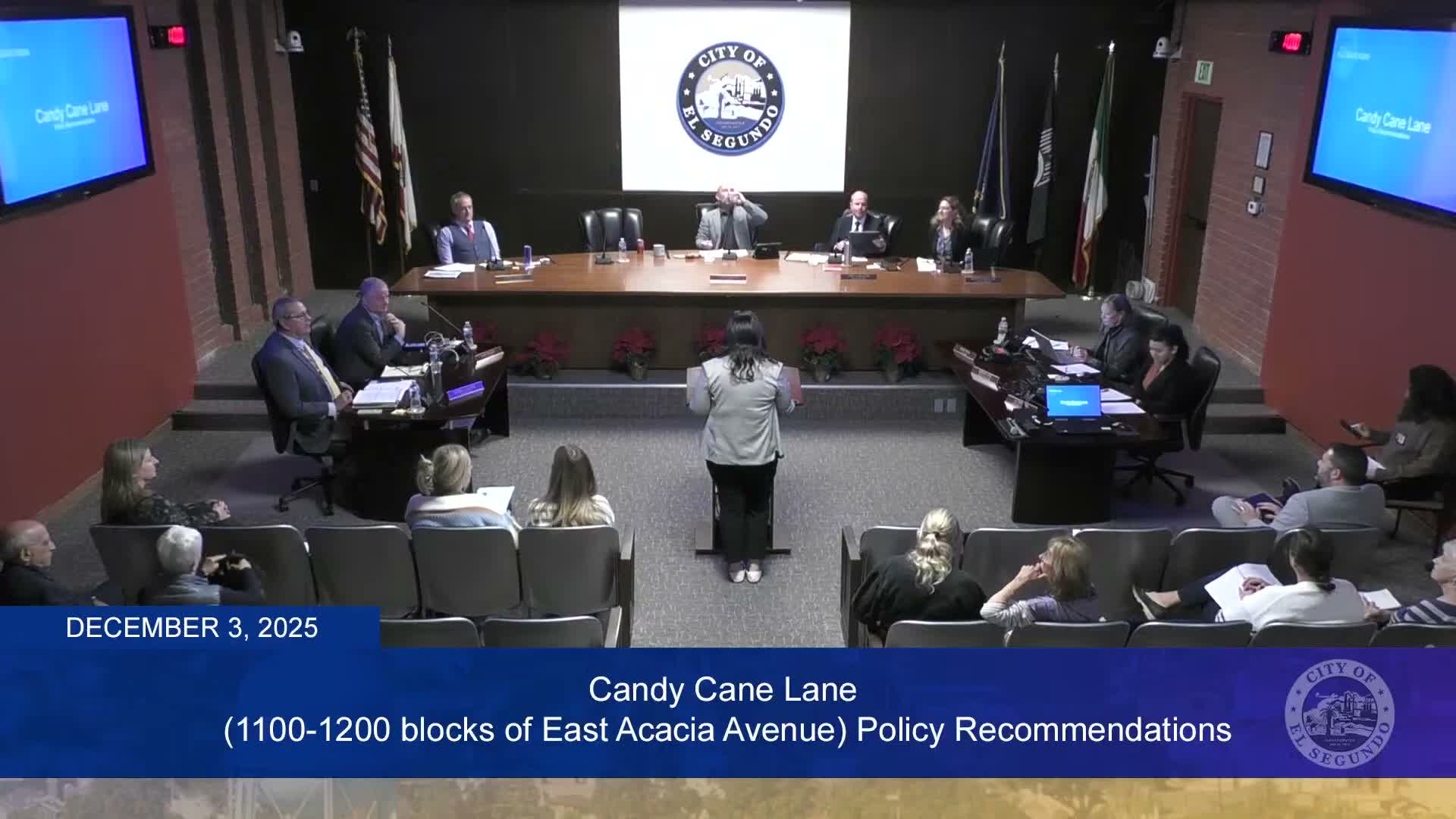
Summary
After weeks of resident complaints and a lengthy public comment period, the El Segundo City Council directed staff to limit vending to five busy nights, begin barricades at 5 p.m. on opening and peak nights, escort residents to their homes, and ask residents to turn off displays at 10 p.m.; staff will monitor outcomes and report back.
El Segundo — The City Council moved Dec. 3 to give staff operational direction aimed at reducing safety and quality‑of‑life problems tied to Candy Cane Lane, the decades‑old neighborhood holiday lights display on East Acacia Avenue that has grown into a regional attraction.
Residents told the council the event has swelled into a major visitor draw, bringing congestion, trash, fights and vendors onto residential streets. “The event has gotten too big,” resident Michael Palillo told the council, saying people now park blocks away and some residents cannot reliably access their homes. Several speakers described human and pet waste, physical fights and persons trespassing onto private property.
City staff framed the issue as one of public safety and liability. Ali Mancini, director of Recreation, Parks and Library, said the city subsidized event support in 2024 at an estimated $63,300 for police, security, trash and portable toilets and warned that added police staffing would drive costs higher. The city’s public works director noted a separate dispute over decorations removed from regulatory traffic signs; staff said the Manual on Uniform Traffic Control Devices prohibits decorations on regulatory signs because they can distract drivers.
Rather than adopt an ordinance, the council gave staff a set of directions to use for the upcoming holiday period. The council said it wants vending limited to five of the busiest nights (staff to start with the opening weekend and the three subsequent busy dates), required sellers to clean up trash tied to their sales, and requested that residents voluntarily turn their displays off at 10 p.m. to encourage crowd dispersal. The council also directed staff to staff barricades beginning at 5 p.m. on opening and peak nights, and to continue the practice of escorting residents to their homes through manned entry points.
Police staff emphasized that a hard closure — keeping pedestrians separated from vehicles — is the safest option. The police chief told council that last year there were two incidents in which drivers failed to obey officers and put pedestrians at risk. Council members agreed safety is the paramount concern while acknowledging these measures shift burdens between different blocks and neighborhoods.
Council members asked staff to treat the first weekend as a pilot: staff will monitor trash and crowd impacts, take photographs and data on whether vendor cleanup commitments are met, and report back to council after the opening so rules can be revised as needed. Staff also described shuttle drop‑off points at Sycamore Park and the recreation area to reduce neighborhood parking pressure.
The city also committed to follow up about garlands removed from lampposts; public works said only decorations on regulatory signs (for example, stop signs) were removed to comply with federal/state traffic control guidance.
What happens next: staff will implement the directed operational changes for opening night (Dec. 13) and the busiest nights, monitor outcomes and return to council with data and recommended changes in a post‑event review.