
Pollard site borings, geothermal and design tradeoffs highlighted as key unknowns for Needham school project
Get AI-powered insights, summaries, and transcripts
Subscribe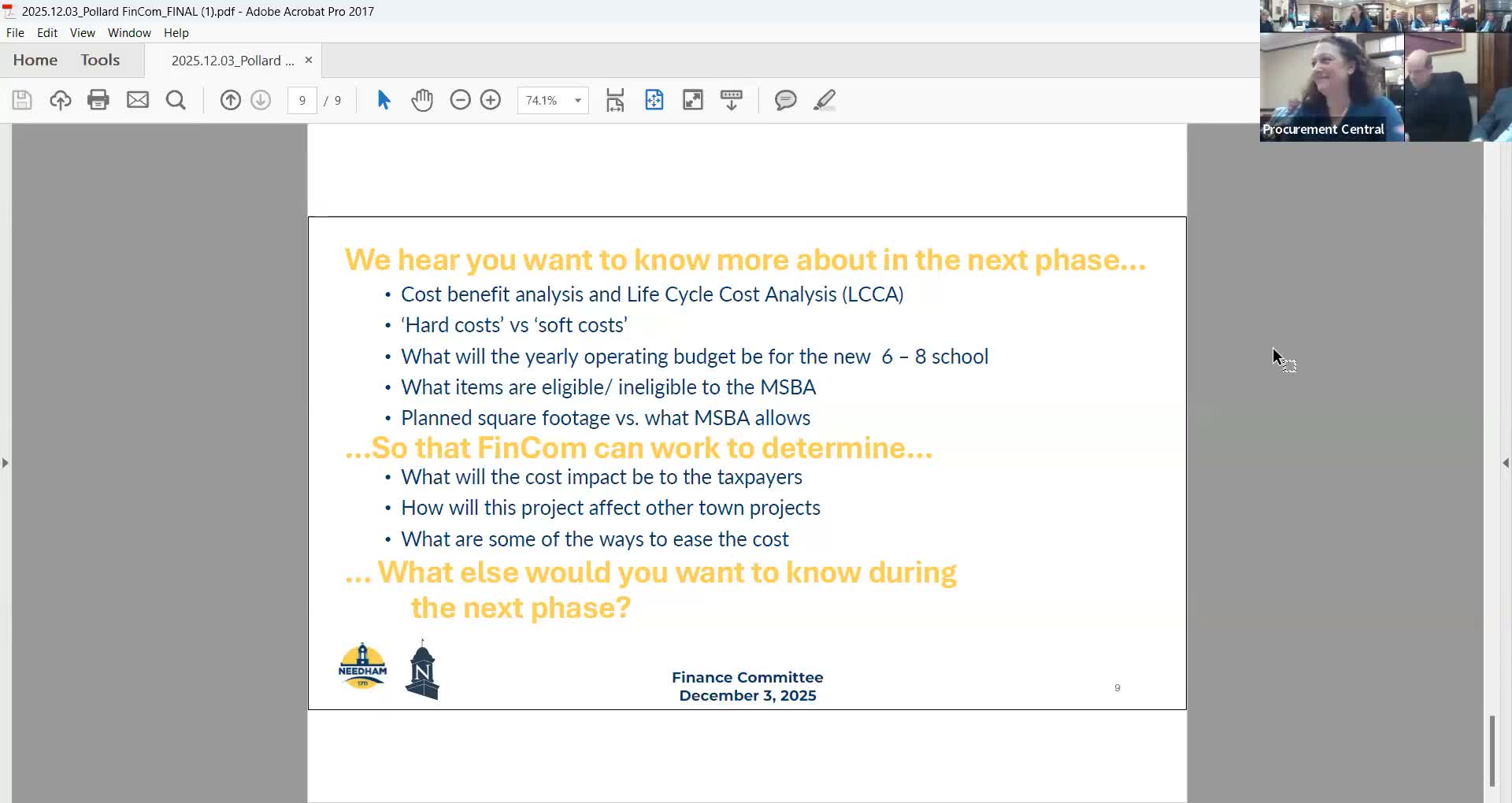
Summary
Committee heard that geotechnical borings are scheduled over the winter break, that soil and site constraints will affect foundation and geothermal design (potentially 80–90 wells), and that proximity to the railroad (options 5D vs 5E) and 3‑ vs 4‑story massing are central design tradeoffs.
Committee members probed subsurface unknowns at the Pollard site and discussed design tradeoffs that will affect cost and schedule.
Speaker 1 said the town has a proposal for test borings and expects on‑site work over the winter break to gather soil and groundwater information. To date, only a phase‑2 environmental around a removed buried oil tank has been done; that test found no contamination in the sampled soils. Speaker 1 said deeper borings and geothermal tests will follow to assess foundation needs and the feasibility of ground‑source heat pumps.
On geothermal, Speaker 1 warned the town could be looking at a large field of wells depending on soil and depth: “we're potentially talking about somewhere around 80 or 90 wells,” he said, but added that soil conditions could reduce or increase that count. Committee members noted geothermal placement is constrained by the existing building footprint and available open space and that placing wells on adjacent parcels could change costs.
Design tradeoffs were discussed in detail: the committee compared options (referred to as 5D and 5E) that differ in distance from the rail line and in building height (3‑story versus 4‑story). Speaker 1 and the architects stressed that 3‑story wings create better light and separation from the tracks, while 4‑story versions and greater setbacks both have cost and program implications. Members asked staff to bring contingency assumptions and CMR input to the May schematic numbers so the committee can better compare options before making recommendations.
Staff also told the committee that early estimates currently carry 10–15% contingency at this stage and that the CMR will provide successive buy‑down estimates during preconstruction.