Get Full Government Meeting Transcripts, Videos, & Alerts Forever!
Get email alerts on the Assessment Accountability topic
No spam. Unsubscribe anytime.
Superintendent advisory council urges BESE to keep current banking of eighth‑grade Algebra 1 scores for one year
Summary
After reviewing 2023–24 data showing roughly 15% of eighth graders took Algebra 1 (about 85% scoring mastery/advanced), the Superintendent Advisory Council voted July 24 to recommend the State Board of Elementary and Secondary Education continue current banking practice for at least one year while more data are collected.
The Superintendent Advisory Council voted July 24 to recommend that the State Board of Elementary and Secondary Education (BESE) continue the existing practice of banking eighth‑grade Algebra 1 scores into high‑school accountability for at least one more year while additional data are collected.
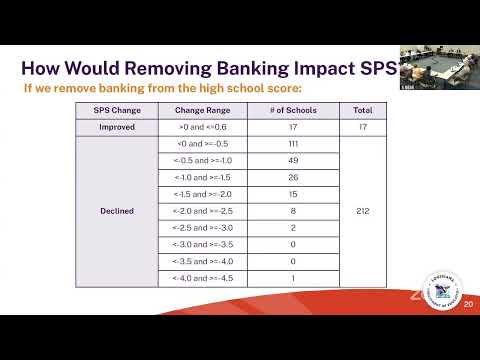
Mr. Thomas Lambert, who presented the department’s analysis, told the council that about 15% of Louisiana eighth graders took Algebra 1 in 2023–24 and that roughly 85% of that group scored mastery or advanced. He said simulations of removing banking produced mostly small changes in school scores: “You see that the amount of change or impact on a score is actually fairly small,” he told members, while also noting some schools could experience larger letter‑grade shifts in the new accountability formula.
Council members raised competing concerns. Several argued banking can misrepresent high‑school performance if middle‑school scores are carried forward. Mr. Beilert and others warned that banking could cause sudden year‑to‑year drops or jumps in public school ratings and said the timing of policy changes — shortly after districts had set staff and master schedules — risked unfair comparisons. “We’re setting cut scores on what our kids did this last year,” one member said, urging caution about changing policy midstream.
Other members emphasized student opportunity and readiness. Several speakers said offering Algebra 1 in eighth grade creates a pathway to advanced math in high school and correlates with higher ACT results for those students. One superintendent noted the risk of limiting parental choice if districts remove eighth‑grade Algebra 1 offerings.
After discussion, Dr. Wardley moved — and Mr. Geiss seconded — a recommendation that BESE retain the current practice of banking the scores for at least another year and then reevaluate after the next round of data collection. The motion passed by voice vote; the chair announced the motion carried.
The council requested additional follow‑up data, including longitudinal tracking of cohorts (geometry and later course scores), subgroup impacts, and growth measures under the new accountability system, to inform BESE’s deliberations. Mr. Lambert said the department could produce more targeted simulations and meet with districts to address local concerns.
Next steps: SAC will forward the recommendation to BESE, which is scheduled to consider the issue at its next meeting; the council expects to revisit the matter after further data collection.