Get Full Government Meeting Transcripts, Videos, & Alerts Forever!
Get email alerts on the Title I Compliance topic
No spam. Unsubscribe anytime.
SPCSA issues Title I compliance guidance for state‑sponsored charter schools
Summary
State Public Charter School Authority staff summarized Title I requirements for sponsored charter schools, covering federal and state legal bases, allowable uses of funds, family engagement rules, paraprofessional qualifications and monitoring expectations.
Brittany Weinhold, an education programs professional with the State Public Charter School Authority, delivered a briefing for SPCSA‑sponsored charter school leaders on Title I compliance and monitoring expectations. "Our goal is to review the key requirements and best practices that will help ensure your schools remain in compliance while also maximizing the impact of federal funding to better serve your students," she said.
Weinhold framed Title I as a federal program under the Elementary and Secondary Education Act as amended by the Every Student Succeeds Act (ESSA), and said Nevada law assigns SPCSA Local Education Agency responsibilities for sponsored schools. She said the agency must implement and oversee Title I requirements and report annually to the Nevada Department of Education (NDE) on performance and federal funding to ensure equitable and transparent use of Title I dollars.
On allowable uses, Weinhold emphasized the supplement‑not‑supplant rule: Title I funds must "add value and directly support students who need the most help rather than covering costs that should already be provided by state or local funding." She listed common allowable uses: hiring interventionists and paraprofessionals, purchasing supplemental instructional resources, funding professional development, and providing tutoring and summer learning opportunities.
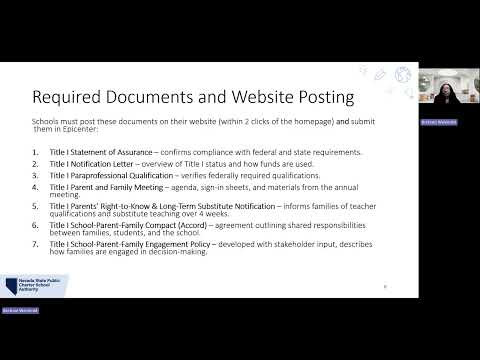
Weinhold highlighted family engagement obligations, calling the annual parent and family meeting "a cornerstone of Title I compliance" and noting it must be held within the first 30 days of school. She said those meetings should explain how Title I funds are used, present curriculum and assessments, share state assessment results and provide clear opportunities for family participation.
The presentation also covered accountability and reporting practices: maintain agendas, sign‑in sheets, meeting notes or minutes, handouts and presentation materials in parent‑friendly formats (with translations as needed) and upload records into Epicenter for SPCSA monitoring. Weinhold reminded leaders that FRL (free/reduced‑price lunch) eligibility affects Title I funding and urged accurate, accessible procedures for determining and reporting eligibility.
The session closed with resource directions and an offer of technical help to schools needing access to NDE or SPCSA systems for monitoring.