
Stevens County approves amended hauler license, readies fee increases as state plans new demolition-landfill rules
Get AI-powered insights, summaries, and transcripts
Subscribe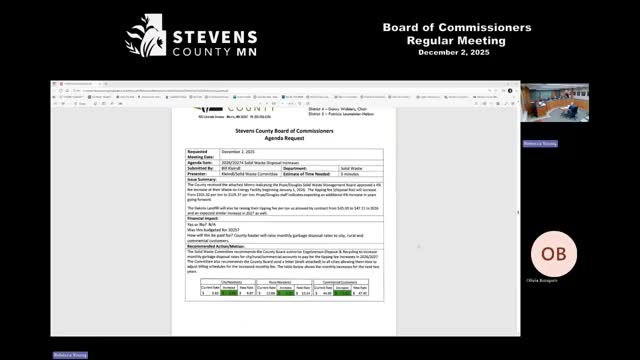
Summary
County commissioners approved changes to solid-waste hauling and local disposal rates after a solid-waste committee warned new state demolition-landfill rules will require liners, leachate controls and financial assurances — forcing higher tipping fees and raising questions about enforcement and future closure costs.
Stevens County commissioners voted to approve an amended solid-waste hauler license and a set of modest local rate adjustments after staff warned that proposed state rules for demolition landfills will raise long-term operating and closure costs.
Solid-waste presenter (S7) told the board the county—s primary incinerator and a regional landfill plan to raise tipping fees beginning Jan. 1, 2026. He said one facility—s disposal fee will move from about $101.32 per ton to roughly $105.30 per ton and another landfill—s rate will increase to about $47.01 per ton. The solid-waste committee recommended passing those costs through to customers so the county can build revenue for future closure obligations.
"This is the maximum that they can put on the county through the contracts that we have with them right now," S7 said, explaining the contractor-driven price change. He added the committee recommended raising monthly residential rates by only a few cents — city residents by $0.05 and rural residents by $0.25 per month — and sending letters to cities to allow them time to adjust their billing schedules.
The county also proposed and approved an amended hauler license that would require demolition waste collected in Stevens County to be delivered to Stevens County demolition-debris facilities. S7 said the change is designed to capture revenue to pay for increasingly expensive landfill closure obligations as the state moves to require synthetic liners, leachate collection systems, capping, and financial assurance for demolition landfills.
Commissioners pressed staff on enforcement. "If they don't comply, the application is revoked," S7 said, adding enforcement would begin with an administrative letter from the county office and could escalate to the county attorney's office for license revocation. Commissioners acknowledged that enforcement is primarily complaint-driven and not foolproof.
The presenter told the board the county—s most recent annual survey (2024) shows roughly 6.5 years of remaining landfill capacity at current fill rates, but demolition volumes have increased in recent months — accelerating the timeline to buy additional liner and closure materials. The county also discussed regional planning models, including a "hub-and-spoke" approach and a $300,000 planning grant to study longer-term options; a consultant deliverable is expected by mid-2026.
The board approved the amended hauler license and directed staff to prepare a letter to the out-of-county operator named in the packet. The motion passed on a voice vote.
What happens next: staff will send the letter to the hauler, implement the licensing change, and begin outreach to cities about the modest monthly-rate adjustments. The county will continue to monitor state rule development and the regional planning study due next summer.