
Nevada school board pauses proposed middle-school accelerated-credit change, approves math and science pathway revisions for next year
Get AI-powered insights, summaries, and transcripts
Subscribe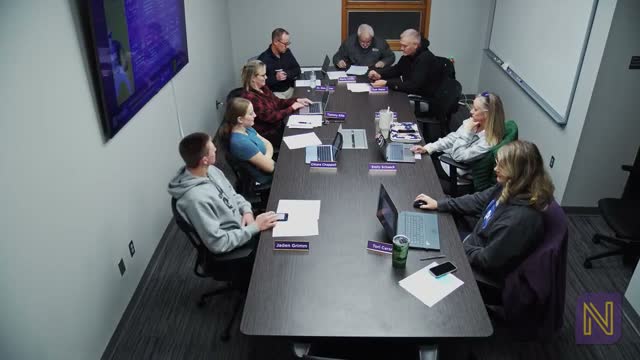
Summary
Administrators presented edits to the 2026–27 course guide proposing that most middle-school accelerated courses count as elective rather than replace high‑school core credits; after parents and board members raised concerns about flexibility, the district paused that proposal and won initial approval for broader math and science pathway changes including a 'math lab' support and a shifted science sequence.
Administrators presented a package of course‑guide changes and pathway revisions at the Nevada Community School District board meeting on Dec. 1, 2025, proposing that middle‑school accelerated courses generally count as elective credit rather than replace required high‑school core credits.
Speaker 5, the administrator presenting the guide, said the intent is to “accelerate students to extend learning. We’re not accelerating students to end learning faster.” The proposal used algebra as an example: an eighth‑grade Algebra I would provide elective credit but the student would still be expected to complete geometry and Algebra II sequencing in high school.
Parents and board members pushed back, saying the change could feel like a “punishment” for students who push themselves early and could reduce schedule flexibility. “I could view this as a punishment for being accelerated,” said Speaker 3, a parent, who asked how students who later shift interests would avoid being forced into additional coursework in subjects they no longer prefer.
Administrators said available local data and anecdotal reviews drove the recommendation. Speaker 5 said district review shows many students who accelerate earlier later stop at the minimum graduation path in some areas; the presenter described an internal estimate—derived from course‑level counts—of roughly half of accelerated instances pausing later work and acknowledged the district does not yet have full longitudinal data.
Because of the concerns and limited hard data, Speaker 5 recommended pausing that specific acceleration language and returning next year with more information. The board agreed to delay action to gather additional student, parent and neighboring‑district information.
Separately, the board supported several related course‑guide shifts intended to strengthen math and science outcomes. The district will discontinue the Foundations/Algebra 1A/1B remedial track, move all ninth‑grade learners into Algebra I paired with a dedicated “math lab” support for students who are not proficient on the ISAS assessment, and add new end‑path options such as a semester‑length Financial Algebra and a restructured Probability & Statistics offering. Speaker 5 described the math lab as an elective credit designed primarily as a semester of targeted practice; placement is data‑driven and families are notified when the district recommends the support.
On science sequencing, the district’s science team recommended shifting the core pathway to Integrated Science → Chemistry → Biology because chemistry standards better prepare students for deeper study in biology. That change will temporarily concentrate chemistry enrollments for a transition year; administrators plan to offer dual‑credit biology second semester to provide access for juniors and seniors.
Administrators committed to refining policy language, posting the updated course guide where parents can find it, and returning to the board with clarified criteria and supporting data before final adoption next year.
The board did not take a final vote on the middle‑school accelerated‑credit language; it approved the broader pathway restructuring as guidance to staff and asked administrators to return with data and clearer, repeatable placement criteria.