Get Full Government Meeting Transcripts, Videos, & Alerts Forever!
Get email alerts on the Penalty Waivers topic
No spam. Unsubscribe anytime.
Tennessee Department of Revenue explains penalty-waiver process, limits and timing
Summary
The Tennessee Department of Revenue outlined how taxpayers can petition to waive penalties (but not interest), the documentation needed, eligibility criteria including a typical two-year good-filing history, and that large waivers (≥ $100,000) require attorney general approval. Processing typically takes 30–45 business days.
Billy Trout, manager of taxpayer education at the Tennessee Department of Revenue, and audit staff told taxpayers how to seek penalty waivers and what to expect.
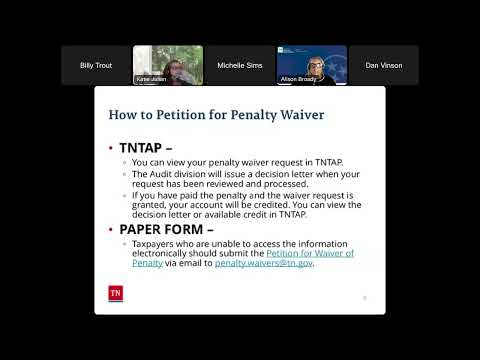
The department said taxpayers may petition for a penalty waiver in TinTap or by submitting a signed paper form. "Interest cannot be waived," Katie Julian said, citing Tennessee law, and the department will not consider a waiver until the tax for the period in question has been filed and paid (or is on an approved payment plan). Michelle Sims, an auditor in the department’s audit division, added: "Any filed returns would need to be filed, and any taxes that are due would need to be paid in order for us to consider that penalty."
Panelists outlined the criteria auditors typically review. Waivers are considered for "good and reasonable cause," and the department generally looks for a two-year record of timely filings and no willful disregard. Michelle Sims said auditors also consider intervening events such as illness or a death in the family and urged taxpayers to document supporting facts in their waiver narrative.
The webinar covered types of penalties that can be considered for waiver—late filing, returned-payment/insufficient funds penalties, and penalties for missed estimated payments—and noted that departments treat penalties by tax type (sales tax vs. franchise and excise) rather than across unrelated account types. The panel advised taxpayers to select all periods they want reviewed in TinTap; partial approvals are possible.
Large waiver requests trigger additional review: "If it's a waiver in the amount of $100,000 or more...that goes all the way up to the attorney general of the state," Katie Julian said, and Michelle Sims noted those petitions can take longer than the typical processing window. Michelle estimated penalty-waiver petitions generally take about 30 to 45 business days to process, and the department cautioned that AG-level sign-offs can extend that timeline.
For paper submissions, Michelle stressed a common procedural reason for rejection: unsigned forms. "Whenever a paper form is submitted, that form must be signed. If that form is not signed, we cannot process that penalty waiver," she said. Katie recommended TinTap for speed and noted a digital-signature flow is available.
What taxpayers should put in a petition: the online form requires narrative responses explaining why the waiver is requested; attachments are optional but recommended when they contain supporting evidence. The TinTap interface also asks filers to attest that the penalty did not result from gross negligence or willful disregard.
Next steps and contacts: the department encourages taxpayers with questions or missing periods to call taxpayer services before filing a waiver; audit staff may ask for additional documentation while evaluating a petition. The penalty-waivers email box is penalty.waivers@tn.gov and the penalties phone line given in the webinar is (615) 837-5363.
The department closed by urging timely filing and payment to avoid penalties where possible and noting that complete, clearly documented submissions speed processing.