Get Full Government Meeting Transcripts, Videos, & Alerts Forever!
Get email alerts on the Budget topic
No spam. Unsubscribe anytime.
Finance committee reviews springfield sd revenues, spending and small state funding gains
Summary
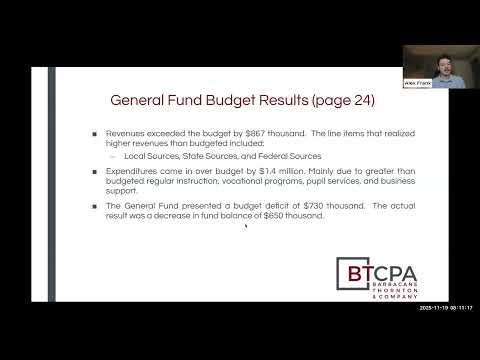
Committee heard administration say general-fund balance fell about $650,000 year-over-year, revenues outperformed budget, and state budget increases will yield a modest local boost; members emphasized preserving fund balance amid future contract obligations and Act 1 constraints.
Miss Green told the finance committee that the district’s general fund decreased by roughly $650,000 in the most recent fiscal year and that year-to-date revenue collections are strong, with about $54 million collected so far. "We collect our revenues very, very quickly," she said, noting that timing of payroll and the 10-month teacher contracts explains why expenditures accelerate later in the year.
Auditors reported that general-fund revenues exceeded budget by about $860,000 and expenditures were about $1.4 million over budget; excluding a roughly $570,000 lease expense recorded under GASB 87 (which is offset by other financing sources), the committee was told expenditures were approximately $820,000 over budget.
On state funding, Miss Green summarized the recently adopted state budget and said Springfield Township SD will receive a relatively small share of the statewide increase because of the district’s enrollment and wealth metrics. She cited examples discussed at a PASBO workshop: the district’s basic-education subsidy may increase by about $166,000 and ready-to-learn block-grant adjustments could add roughly $50,000 for districts that previously received none. She also noted a sizable statewide increase in special-education appropriations.
Committee members urged caution about spending new, small state allocations. One member said the district should prioritize maintaining a healthy fund balance rather than immediately expanding operating spending, arguing that fund balance provides optionality for unanticipated cost pressures.
Miss Green and committee members discussed longer-term constraints: the Act 1 index is expected to decline over the next five years, and the district has contractual obligations that include salary and benefit increases for some employee groups; the teachers’ contract negotiations in 2027–28 were flagged as an upcoming budget pressure.
Next steps: administrators will continue to pursue fund-balance reduction strategies, monitor state and federal funding flows, and develop the FY26 budget with an emphasis on balancing contract obligations and limited revenue growth.