
Norwood committee advances policy package and sends several new policies for public input; friends seek clarity on grounds access and capital definitions
Get AI-powered insights, summaries, and transcripts
Subscribe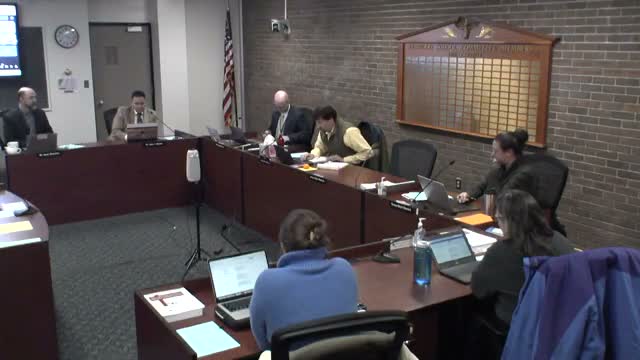
Summary
The committee voted unanimously to send multiple revised and new policies for public input and approved two graduation/competency policies. Members debated an access-to-school-grounds policy and asked the finance commission to clarify a $50,000 capital threshold in a newly created capital stabilization policy.
At its Dec. 3 meeting the Norwood School Committee advanced a broad package of policy changes — voting to send several revised and new policies for public input and approving two graduation-related policies after a lengthy subcommittee review.
Policy subcommittee members and district staff walked the committee through multiple policy sections. The policy set included non-substantive consent items and several substantive changes: safety and emergency plans, access to buildings and grounds (ECAB), revisions to student transportation and student-conduct-on-buses rules (EEAC R), meal-modification and universal school-meal language (EFBA, EFC), a new civil-rights complaint policy tied to child-nutrition programs (EFE), district data-security and records-retention policies (EHAA, EHB), and a split of graduation requirements into IKF (graduation requirements) and IKFE (competency determination).
A central debate centered on ECAB, the access-to-building-and-grounds policy. Committee members asked whether posting school hours or agreeing protocols with town departments would be sufficient, and raised potential unintended consequences — for example, whether parents who cross from adjacent town facilities to use a playground before/after pickup would be prohibited when school is in session. One administrator summarized the policy goal: when students are in school and under district responsibility, access should be limited to district students, staff and authorized visitors; “When school is in session and our kids are under our responsibility... other families or adults or people that we don't know should not have access to where our kids are,” a district official said.
The committee moved the policy package with a roll-call vote after a motion that combined items to be submitted for public input, items to approve and one rescission. Joan made the motion; Theresa seconded. The roll-call recorded five ayes (Anne Marie Mazzola, Judith Bromley, Joan Giblin, Theresa and the chair) and no nays, and the motion passed 5–0. Among the items approved were IKF and IKFE (the graduation and competency determination documents). The committee also pulled one set of executive-session minutes from the consent agenda for separate discussion.
Separately, the committee discussed a capital stabilization fund policy that follows a town meeting appropriation of $2 million. Eric Fleming, vice chair of the Norwood Finance Commission, explained the fund is intended for unusual or timing-sensitive capital needs (for example, when free cash is low or borrowing costs are high). Members asked whether the policy’s definition of capital (a $50,000 threshold for this fund) might conflict with other capital policies and affect technology requests; they voted to ask the finance commission to review those concerns and to defer final approval pending that review.
Next steps: the policies sent for public input will enter the public-comment process, administration will return requested demographic or budget clarifications for items flagged during discussion, and the finance commission will return with answers on the capital policy’s definition of capital prior to final action.