Get Full Government Meeting Transcripts, Videos, & Alerts Forever!
Get email alerts on the Nerf And Modeling topic
No spam. Unsubscribe anytime.
Presenters describe proposed New East Branch Russian Facility and modeling that limits summer diversions
Summary
Russian Project Authority presenters described the proposed NERF pumping plant (10to300 cfs capacity) and modeling showing seasonal limits; the water diversion agreement assigns a 50-year contractual delivery arrangement with Round Valley Tribe holding the water right exercised by the IRPA.
David Manning, executive director of the Russian Project Authority, presented the technical design principles for the proposed New East Branch Russian Facility (NERF) and explained how operational rules are intended to protect Eel River fisheries while allowing seasonal diversions.
Manning described a four-season set of "floor" flows that must remain in the Eel River; only flows above those floors can be diverted, and a ramping rate (20to30% of available flow) is used so diversions do not cause abrupt drops in the rivers hydrograph. "The new industrial facility is being designed to pump between 10 and 300 CFS when water is available," he said.
Modeling examples shown to the meeting demonstrated wide variability by water-year type. In a wet-year simulation the NERF could divert up to 86,000 acre-feet but storage constraints in Lake Mendocino reduced the amount actually captured and stored in that example to about 24,500 acre-feet. Panelists said average modeled deliveries through the tunnel under the proposed rules would be roughly 30,000 acre-feet per year, while historical operations delivered much larger volumes in the hydroelectric era.
On governance and rights: presenters said the water diversion agreement provides that the Round Valley Tribe will hold the water right while the Yule-Russian Project Authority (IRPA) will exercise delivery via contract; the agreement is described as a maximum 50-year term (initial 30 years with prescriptive conditions that can automatically extend it by 20 years).
Environmental review: Manning said the IRPA-led CEQA process (an EIR) and FERCs NEPA-level review will run in parallel; he estimated the CEQA process will take about 24 months and said the broader surrender and implementation timeline could extend toward 203031. He also noted the public should track both state and federal comment opportunities.
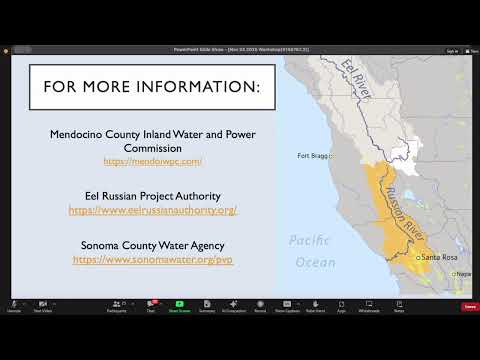
Ending: presenters said full modeling, feasibility and technical reports are posted on the project website for review.