Get Full Government Meeting Transcripts, Videos, & Alerts Forever!
Get email alerts on the Mosquito Abatement topic
No spam. Unsubscribe anytime.
Committee urges tighter oversight of St. Tammany Mosquito Abatement District, recommends cutting millage toward 2 mills
Summary
After extended public comment and a district rebuttal, the St. Tammany Parish government efficiency committee voted to forward recommendations to the full parish council to reduce the mosquito abatement district millage toward roughly 2 mills, review laboratory operations and seek legislative changes to allow parish budgetary oversight.
The St. Tammany Parish government efficiency committee voted unanimously on Nov. 7 to forward a package of recommendations to the full parish council aimed at tighter fiscal oversight of the St. Tammany Parish Mosquito Abatement District and a proposed reduction in its millage rate.
The committee’s recommendations, presented by the chair and approved by voice vote, ask the council to maintain the district’s dedicated funding but move the millage closer to about 2 mills — a level the chair said would generate about $6.2 million annually — require an expert review of the district’s laboratory operations and pursue changes in state or special local law so the parish council has budgetary authority over the district.
Why it matters: Committee members and public speakers said the district collects significant tax revenue and that taxpayers are near capacity for new levies. Critics at the meeting urged fiscal restraint and greater transparency; district counsel defended the district’s practices and said it had publicly presented its plans and was the subject of pending litigation.
Long public comment period Glenn, a mechanical engineer who identified himself as having reviewed the district’s operations, told the committee he visited the St. Tammany Mosquito Abatement District and that its new laboratory can produce “real time testing” that “enables infill treatment response time reduction by 4 days versus using LSU lab services.” He accused some opponents of conducting biased investigations and called for “accountability related to the wasteful and biased investigation.”
A second public commenter delivered an extended critique of district spending and benefits, citing an $8 million facility expansion, higher-than-comparable salaries and benefits, frequent travel and purchases such as helicopters and an unused spray plane. The commenter urged the committee to press the district to reduce millage and open its financial records to public oversight.
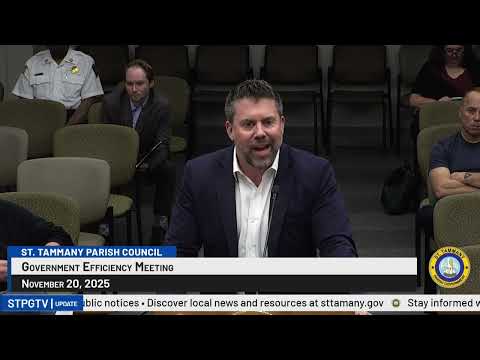
District response Chris Handy, legal counsel for the Mosquito Abatement District, told the committee the district “has always been committed to transparency” and that its written rebuttal and a public presentation addressing testing, benefits, fleet and patent questions had been circulated to the council. He said the district’s plans — including a smaller laboratory as part of a larger project and a patent strategy — were intended to address local conditions and could, in the district’s view, lead to long-term savings or benefits.
Recommendations and next steps The committee’s four recommendations, as read into the record by the chair, were: keep a dedicated millage for the district but improve management; reduce the millage toward roughly 2 mills (estimated to produce about $6.2 million annually); commission expert review of the laboratory and other questionable expenditures; and pursue statutory or special-law changes to give the parish council budgetary oversight of the district. The chair also urged adding business expertise to appointed boards.
The committee moved to send the recommendations to the parish council for final decision; the motion was seconded by Councilwoman Cheryl Tanner and carried in a voice vote. The committee did not take additional action on specific contracts or personnel at the meeting.
What was not resolved District counsel said the matter was the subject of pending litigation and that some district officials declined to attend the committee hearing for that reason. The committee did not enact immediate budget cuts or change the district’s governance at the meeting; it referred its recommendations to the full council for potential legislative and procedural follow-up.
The committee closed the Mosquito Abatement District item and briefly discussed public works efficiency before adjourning. The committee said there will be no December meeting; it will reconvene in January.