Get Full Government Meeting Transcripts, Videos, & Alerts Forever!
Get email alerts on the Development Code topic
No spam. Unsubscribe anytime.
Tualatin Council reviews plan to align development code with state—lear-and-objective housing standards
Summary
City staff told the council the Tualatin Development Code will be audited and revised to meet state "clear and objective" housing standards, with a draft due June 2026, a revised draft in August, and a formal hearing planned for fall 2026. Staff said the January memorandum will show affected sections and policy choices.
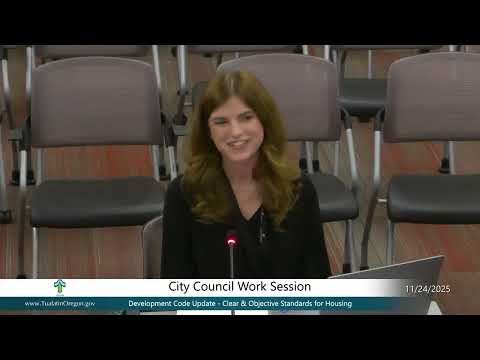
Madeline Nelson, associate planner for the city of Tualatin, told the council the city has launched a project to audit and update the Tualatin Development Code to use clear and objective language for residential housing. "The purpose of the project is to audit and update the TDC to create an adoptable code that meets Oregon revised statutes," Nelson said, citing the statute staff referenced in the presentation.
Nelson said the city retained consultant MIG, with grant funding from DLCD, to complete the audit and draft code language. As an example of the change in approach, she contrasted subjective standards such as requiring buildings to be "compatible with the character of surrounding development" with measurable rules: "building facades must include at least 30% windows or doors on street-facing elevations," she said, explaining the statute seeks language that is "specific, measurable, and enforceable."
Staff provided a schedule for the project: a draft potential code update will be prepared in June 2026, a revised final draft in August 2026, and a final adoptable code and formal hearing planned for fall 2026. Nelson said staff will return to the council in January with the audit memorandum and to seek policy direction based on the audit findings.
Councilors used the Q&A to press on scope and local discretion. Councilor Hilliard asked whether the audit will examine where the city can "push back" on state standards or retain local autonomy, citing parking requirements as an example; Nelson said the consultant—s scope is narrow to housing but the memorandum will identify possible areas for local discretion and provide guidance for policy choices. Councilor Pratt asked whether the work will only meet statutory rules or also simplify procedures for developers; Nelson replied the memorandum will identify procedures that do not conform to clear and objective standards, and the intent includes making it easier for developers to implement housing in the city.
Councilors also asked about the role of advisory bodies and the Architectural Review Board (ARB). Nelson said the consultant will produce draft audit and code language and will work with staff, the planning commission and city council on implementation; ARB is not currently scoped to provide feedback but staff will consider including it if appropriate.
Next steps: staff will bring a code-audit memorandum to the council in January outlining affected code sections and policy choices, followed by draft code language next summer and a formal public hearing on an adoptable code in the fall of 2026.