Get Full Government Meeting Transcripts, Videos, & Alerts Forever!
Get email alerts on the Land Use Development topic
No spam. Unsubscribe anytime.
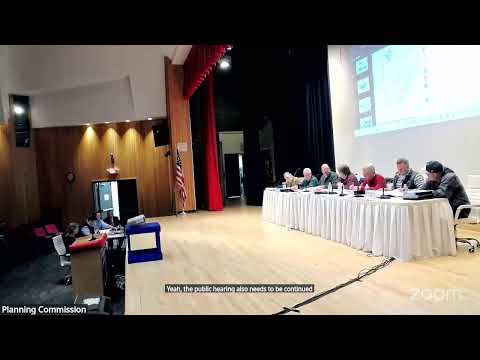
Coventry planning commission opens public hearing on 176‑unit ‘Village at Tioga,’ grants submission waivers and continues review
Summary
The Coventry Planning Commission heard technical presentations and hours of public comment on the Village at Tioga, a proposed 176‑unit development with 25% affordable units, granted four submission waivers to certify the application complete and continued the public hearing to Dec. 18.
Coventry — The Planning Commission opened a public hearing on the Village at Tioga preliminary plan on a roughly 27‑acre site next to Tioga Lake, heard a technical presentation from the applicant and peer reviewers, and accepted four submission waivers that the applicant said are necessary to make the filing complete.
Joelle Rocha, representing 232 Realty Associates, told the commission the proposal calls for 176 housing units in three distinct areas and that at least 25% of the units would be deed‑restricted as affordable. “This is a middle‑income project,” Rocha said, and the application requests limited submission waivers for some checklist items because the team intends to refine design details after receiving planning board feedback.
Civil and traffic consultants then walked through the plans. Leonard Bradley, the applicant’s civil engineer, described the three‑part site layout, a stormwater system sized to treat rooftop and roadway runoff and a proposed sewer pump station that will convey sewage off‑site. Bradley said the stormwater design follows the Rhode Island stormwater manual, that stormwater will be treated and routed to a wetland that connects to Tioga Lake, and that he expects a Department of Environmental Management (DEM) permit after responses to technical comments. “We have overdesigned some of the drainage system to help relieve some of that,” he said.
Paul Bannon of Crossman Engineering presented the traffic impact assessment and estimated the 176‑unit development would generate about 108 vehicle trips in the morning peak and 138 in the afternoon peak distributed across three access points. Bannon and the project peer reviewer, John Chevlin, both recommended improving Tiffany Road and carrying key widenings where feasible; Chevlin also suggested at least one internal sidewalk for the largest cul‑de‑sac to improve pedestrian safety.
Residents who spoke during an extended public comment period urged caution. Kristen Baron, a neighborhood resident, said the area faces “overwhelming drainage issues and flooding,” questioned whether homeowners associations will reliably maintain complex stormwater infrastructure and called for stronger guarantees. Several lakefront residents described recent water‑quality problems at Tioga Lake — high enterococci test results and cyanobacteria blooms — and warned that additional runoff or routine maintenance failures could worsen ecological and public‑health risks. Other speakers cited concerns about emergency access, parking, narrow local roads, school drop‑off congestion and the cumulative effect of multiple nearby developments.
Commission action and next steps
After the presentations and public testimony the commission voted, by voice votes recorded in the meeting, to grant four submission waivers requested by the applicant: to defer permanent bounds and corner markers; to defer the full depiction of proposed improvements (streets, lot lines, setbacks and lot dimensions) until the plan is more developed; to allow a conceptual open‑space plan at preliminary review with the full plan at final; and to waive the required tree‑over‑50‑years inventory as a submission item at this stage. Planning staff advised that, with those waivers, the application could be certified complete and that the statutory review clock would begin as a consequence.
The commission also asked staff to seek an advisory opinion from the Conservation Commission (the Conservation Commission is scheduled to meet Dec. 11) and continued the public hearing and application review to Dec. 18 at 6:30 p.m. in this hearing room.
What remains unresolved
Speakers and commissioners asked for specific follow‑up items the applicant must provide before a final decision: (1) copies of correspondence and capacity letters documenting sewer approvals and where the sewer ultimately ties into the regional system; (2) clearer plans showing whether internal roads will be public or private, the width of proposed roadways if they become public, and where ownership and maintenance responsibilities will lie; (3) a conceptual open‑space and buffer plan showing what natural areas will be preserved and how lake buffers will be protected; (4) definitive commitments on HOA operation, maintenance schedules and, if necessary, legal remedies to ensure long‑term upkeep; and (5) the DEM wetlands/stormwater permit or documentation of outstanding DEM comments.
The commission’s votes to waive checklist items were recorded as voice votes in the meeting minutes; the transcript does not include roll‑call tallies for those motions. The hearing will reconvene Dec. 18, when the commission expects to review additional materials and the Conservation Commission’s advisory comments.