Get Full Government Meeting Transcripts, Videos, & Alerts Forever!
Get email alerts on the Driveway Map Note topic
No spam. Unsubscribe anytime.
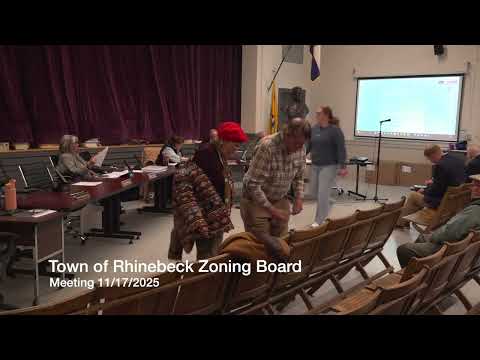
Rhinebeck planning board upholds recorded map note, continues driveway dispute to Dec. 15
Summary
The Rhinebeck Planning Board found no clear “material change” to justify overriding a recorded map note that requires driveway access from the common access (Barrett/Barter/Bear Tyler Drive); after heated public comment the board rescinded an attempted closure and continued the hearing to Dec. 15 while directing staff to prepare a draft denial resolution.
The Town of Rhinebeck Planning Board on Nov. 17 signaled it will enforce a recorded subdivision map note that requires driveway access from the shared/common access rather than allowing the applicant’s proposed driveway location.
Board members repeatedly told the applicant they did not see a “material change” in circumstances that would permit overriding the map note, citing sight‑distance concerns, wetlands and the history of previous planning board deliberations. "I, for one, can't see a reason why the drive can't be constructed off of Barrett Tyler," said Unidentified Speaker 12 (Planning board member).
The dispute centered on whether recent engineering and DEC correspondence — which the applicant submitted and which the applicant said supported a 2025 driveway location — constitutes new evidence sufficient to alter the recorded requirement. The applicant’s representative said the team had provided studies and DEC review and urged the board to keep the public hearing open: "We've spent two years arguing about this driveway, and we've shown you time and time again how it makes sense... and then DEC agrees," said Unidentified Speaker 9 (applicant representative).
Procedurally, the board first moved toward closing the public hearing and drafting a denial resolution because the application did not meet the recorded map note. After applicants objected and asked for an opportunity to supplement the record, the board rescinded the closure and voted to continue the hearing to Dec. 15 to allow additional options and for staff to prepare a draft resolution (denial language) for review.
What happens next: staff will prepare a denial draft that cites the code and factual basis for a denial, per board direction. The applicant may return with alternative driveway options; the board indicated it will want clear documentation of any material change before it would consider overriding the recorded map note.
Why this matters: the decision preserves the legal effect of recorded map notes and subdivision decisions in Rhinebeck, reinforces the board’s deference to prior site‑specific determinations (sight distance, lot configuration, wetlands), and leaves the applicant with a path to either revise the proposal or pursue a new application.