
Orange County moves preliminary water and wastewater rates to public hearing amid rising costs
Get AI-powered insights, summaries, and transcripts
Sign Up Free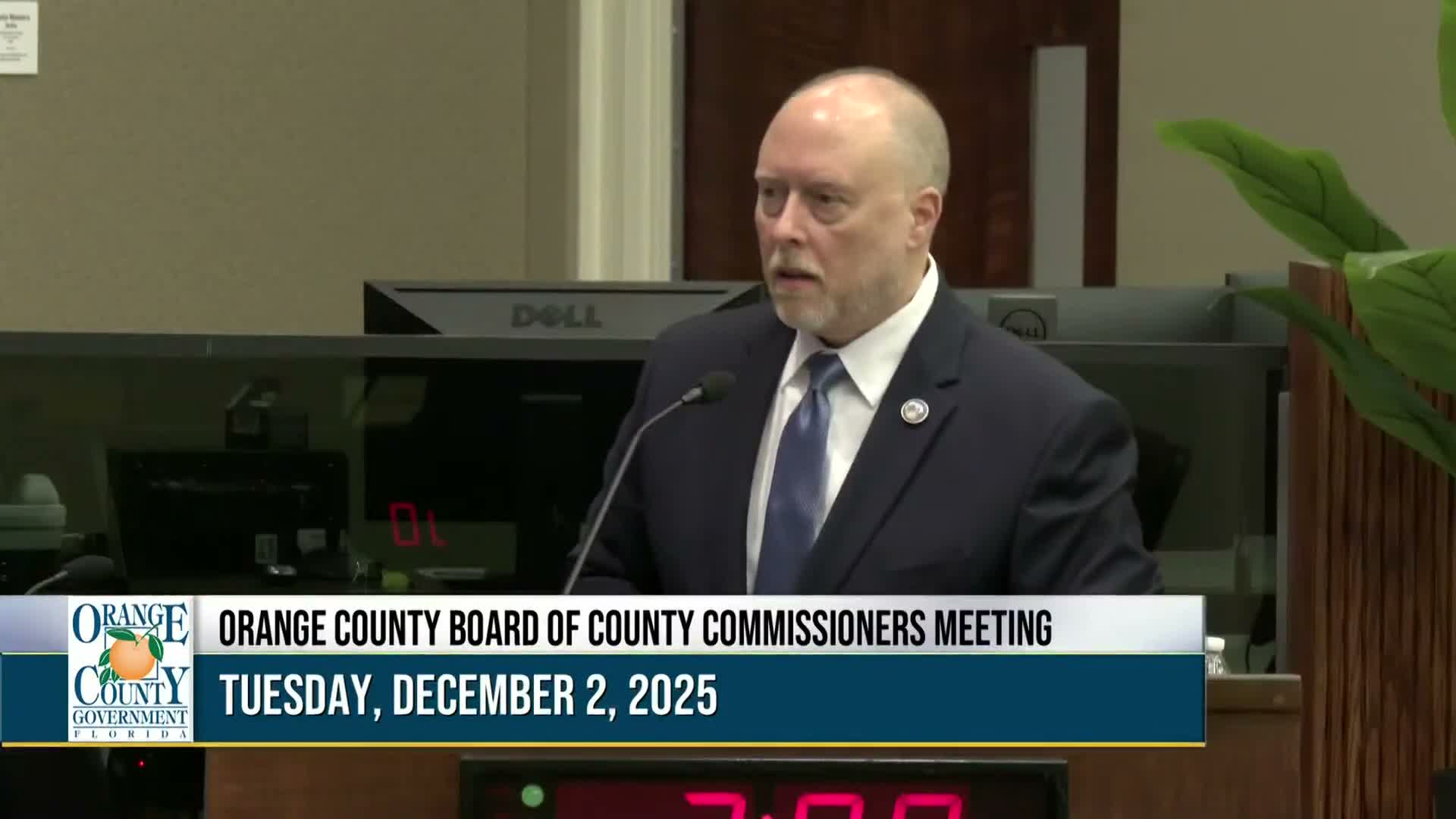
Summary
After a detailed presentation on rising capital and operating costs, commissioners unanimously approved preliminary water and wastewater rate schedules to be finalized at a Jan. 27 public hearing; staff said average residential bills would rise modestly while the plan avoids larger debt borrowing.
Orange County commissioners on Dec. 2 advanced preliminary water and wastewater rate schedules to a public hearing on Jan. 27, 2026, after staff described sharp post‑pandemic increases in construction and operating costs that threaten utility finances.
Glenn Kramer, manager of the county’s utilities fiscal administrative support division, said the county’s 2022 five‑year rate plan no longer covers current expenses because key inputs — electricity, maintenance, chemicals and biosolids disposal — have risen significantly. Kramer said construction costs for pipe and pump stations have increased dramatically: “Back in 2020, we built the Hamlin Water Reclamation Facility 5 MGD for $111,000,000; the next 5 MGD is estimated at $184,000,000,” he said, illustrating rising capital costs.
Andy Burnham of Stantec Consulting, the rate consultant, summarized the recommended adjustments. The plan would raise system revenues about 7.7% per year on average to reduce future borrowing and preserve debt‑service coverage. Burnham said the net effect for a typical residential customer would be roughly a $4 monthly increase by 2031, while higher‑use customers could see $5–$6 rises as the plan phases in. He added the proposal would avoid about $250 million of additional borrowing compared with the status quo.
The presentation included several targeted changes: updating wastewater environmental surcharge rates to better recover costs (total phosphorus up about 45% in the recalculation), adding a lateral installation/repair fee billed at cost for developers, and creating a reinspection fee for environmental program follow‑ups set at $48 per hour with a one‑hour minimum. Kramer also said meter installation charges and reclaimed‑water rate changes already implemented are projected to yield roughly $900,000 and $5.3 million annually, respectively.
Commissioners pressed staff on customer impacts, equity, and conservation. Commissioner Nicole Wilson said outreach should emphasize conservation measures that help households reduce bills. Commissioner Moore asked for simple consumer‑facing messaging; Kramer said the utilities would provide bill calculators, postcards, targeted outreach to top customers and community forums. Commissioner Uribe and others requested modeling scenarios and market comparisons; staff said consultants ran stress tests and normalized historic outliers to produce conservative assumptions.
Mayor Demmons corrected the requested motion language to include approval and execution; the board approved the preliminary schedules unanimously and directed staff to proceed to the public‑notice and hearing steps. Kramer said any final increases would not take effect until after the January public hearing and that, if adopted, the new rates would be scheduled to become effective Oct. 1, 2026.
Next steps: staff will conduct customer outreach, post an online bill calculator, and return to the board after the Jan. 27 hearing for final adoption. The board did not adopt final rates on Dec. 2; the action forwarded preliminary schedules to the statutorily required public hearing.