
North Providence council hears Good Energy Community Choice pitch, refers plan to finance committee
Get AI-powered insights, summaries, and transcripts
Subscribe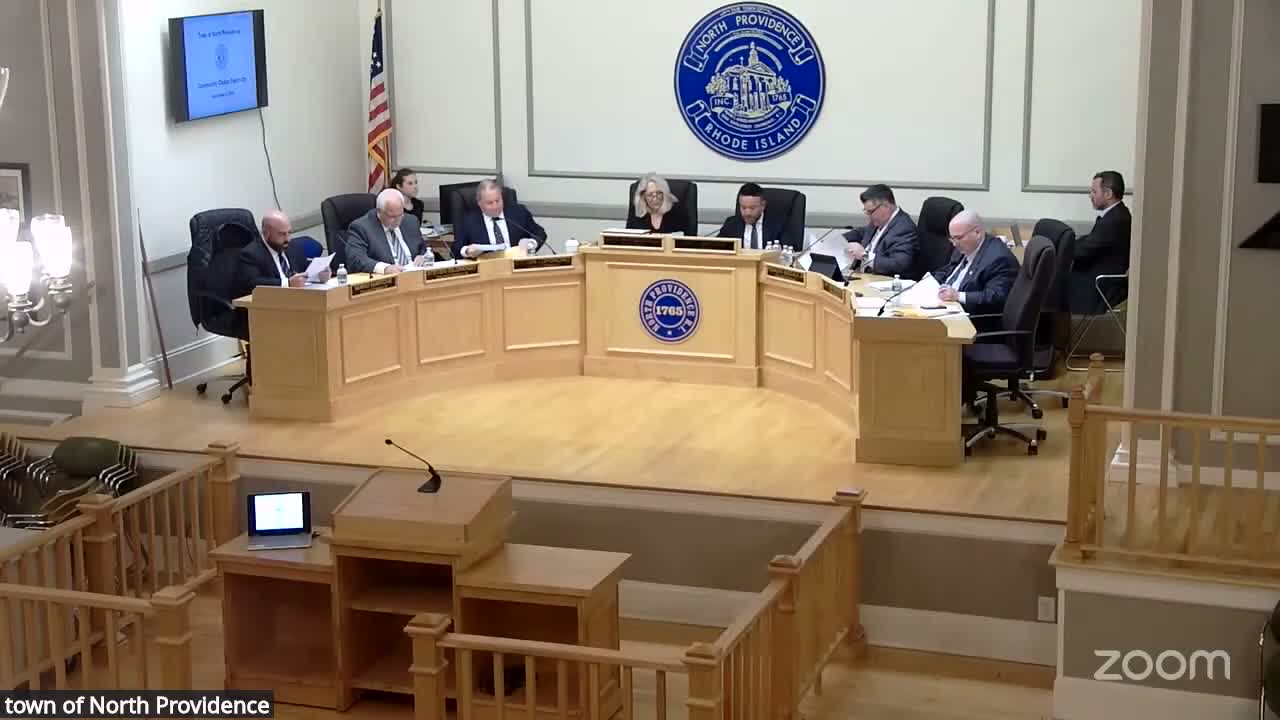
Summary
Good Energy presented municipal 'community choice' electricity options, claiming roughly $2.8 million saved for Rhode Island clients and offering basic and 100% renewable supply options. Council referred the proposal to the Finance Committee for further study and consumer‑protection review.
Good Energy consultants John O'Rourke and Steve Di Natale presented Community Choice aggregation to the North Providence Town Council on Dec. 3, describing how the program would change only the supplier line on residents' Rhode Island Energy bills while leaving delivery and existing utility programs unchanged. Mayor Lombardi introduced the item and said the company had been invited to explain potential savings.
O'Rourke told the council Good Energy works with national suppliers and municipal officials to run aggregation programs, citing 71 Massachusetts clients and seven in Rhode Island. He said participating programs in Rhode Island have produced just under $2,800,000 in cumulative savings for roughly 100,000 residents over about 20 months, and described a consultant fee of “one tenth of a penny per kilowatt hour” (0.001 $/kWh). He outlined three product options: a basic plan meeting Rhode Island's statutory minimum renewable requirement (currently 34%), a modestly higher renewable share, and a 100% renewable option for customers who choose it.
Council members and residents asked detailed questions about timelines, contract lengths and protections for seniors. O'Rourke said contracts typically range from 12 months up to the last bid they ran (42 months), and that residents can opt out at any time without penalty via a postcard, phone call, or a website set up by the winning supplier. He acknowledged prior reports of double billing in an individual transition and explained that, in successful municipal aggregations, customers receive a notice and the utility continues to issue a single consolidated bill that lists the aggregation supplier as a line item.
Council members pressed how Good Energy compares to local competitors (Colonial Power, Peregrine Energy); O'Rourke emphasized the company's national experience and market‑timing capability to seek bids during favorable market windows. Multiple speakers asked for data showing the utility default rate versus proposed aggregation rates: O'Rourke quoted the current Rhode Island Energy default rate as 0.1477 $/kWh and said Good Energy's basic plan figure in the presentation was about 0.14447 $/kWh.
After questions and public comments, Councilman LaPorteo moved and Councilman Martone seconded a motion to send the Community Choice proposal to the Finance Committee for a deeper review of savings estimates, consumer protections for seniors and the opt‑out process. The motion passed on a voice vote.
Next steps: the Finance Committee will review the Good Energy plan, request comparative bids or rate histories as needed, and report back to the full council before any ordinance or authorization is placed on a future agenda.