Get Full Government Meeting Transcripts, Videos, & Alerts Forever!
Get email alerts on the Policy Governance topic
No spam. Unsubscribe anytime.
Policy advisory committee advances consolidated tech and cybersecurity drafts to school committee
Summary
The committee agreed to consolidate the Responsible Use of Technology, log-on usage, Internet filtering (CIPA) and the written information security program and move those drafts to the school committee for first-read consideration; members asked for clearer user definitions and parent communications about filtered categories.
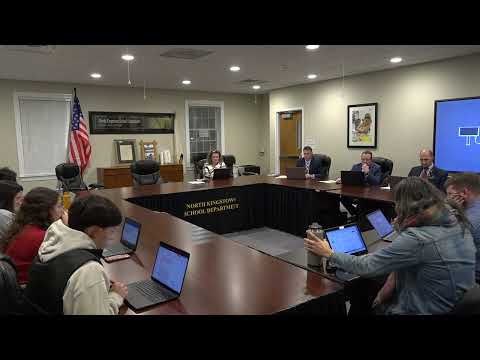
The North Kingstown Policy Advisory Committee voted on Nov. 24 to advance consolidated drafts of the district's technology-related policies — Responsible Use of Technology, log-on usage, Internet filtering to meet CIPA requirements, and the Written Information Security Program (WISP) — to the school committee for a first read.
Committee members, including Rob Azadi (assistant superintendent) and Chester Paco (IT supervisor), recommended combining overlapping sections to reduce duplication and to default to CIPA language where federal requirements apply. Chester Paco told the committee that CIPA requires a district policy on filtering and that, where practical, the Internet filtering definitions should be placed alongside the CIPA compliance statement so the district can cite the federal standard as its minimum.
Members asked staff to clarify the policy's scope language — specifically what the policy means by “user,” and whether that term should explicitly include staff, students and guests. They also requested that IT and administration work on clearer parent-facing communications describing which categories are filtered and how classroom-level blocking works.
On the WISP draft, the committee updated headers and operational terms; examples of changes include replacing “chief operating officer” references with “assistant superintendent” and changing “two-factor” to the more current term “multifactor” authentication. Committee members also suggested referencing a nationally recognized cybersecurity framework to guide future updates.
A motion to move the consolidated technology drafts to the school committee was made and seconded; the committee agreed to advance the drafts by voice vote (the transcript records the motion and second but does not include a roll-call tally). The school committee will receive the drafts for a first reading and can return them to the advisory committee with edits or request additional workshops.