
Board discusses impact on center‑based special‑education rooms if elementary sites are consolidated
Get AI-powered insights, summaries, and transcripts
Subscribe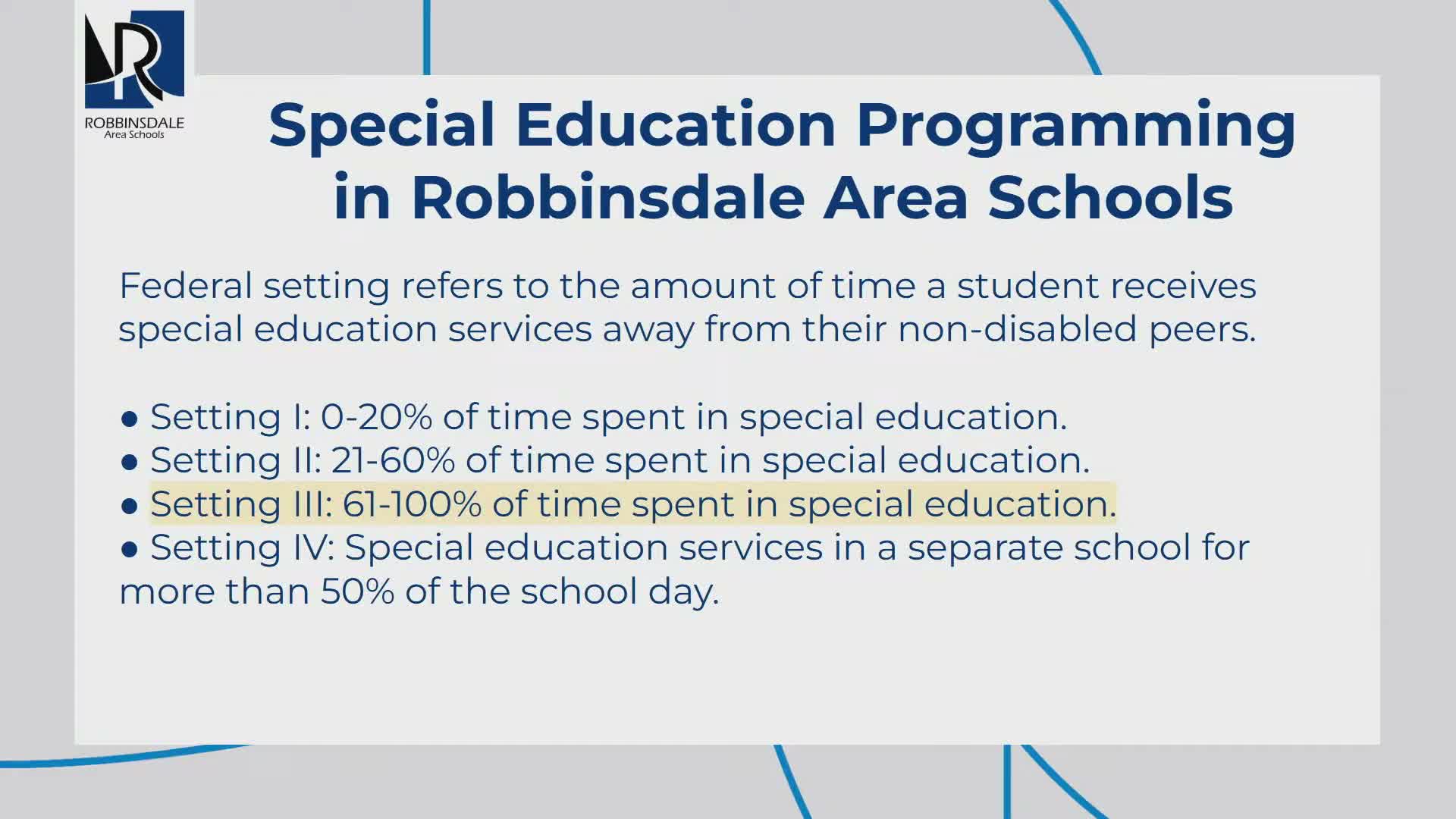
Summary
Administrators told the board the district currently has 28 elementary center‑based classrooms and expects to need 32 next year; several closure scenarios would require re‑placing 9–15 center‑based rooms and could force specialists to work 'on cart' if space is constrained.
District special‑education staff used the Nov. 24 study session to explain how proposed elementary consolidations would affect center‑based (federal setting 3) programming and rooming needs.
Assistant Superintendent Dr. McDowell said setting 3 students — who may spend 61% to nearly 100% of the school day in special‑education services — are served in center‑based classrooms that are provided only at select sites. "We currently have 28 elementary center based classrooms. We anticipate needing 32 next year," he told the board.
Staff modeled four closure pairings of the schools under consideration. In the scenario closing Sonocent and Neil, administrators said the district would need 15 room 'adjustments' (existing center‑based rooms that must be relocated plus the additional four assumed rooms). Other permutations produced 9–13 adjustments, depending on which sites remain open. Administration characterized an 'adjustment' as a mix of student moves, room repurposing, and other space reconfigurations rather than a single uniform action.
Board members pressed staff on where center‑based classrooms could be located if neighborhood schools no longer have capacity. Dr. McDowell said every elementary room would be reviewed — small breakout rooms, media centers and multipurpose spaces could be repurposed — and noted some rooms (e.g., sensory or calming rooms) must be preserved or recreated when students move. He cautioned that certain configuration choices could require specialists to deliver services via portable carts during the transition.
Board members also asked about costs for physical retrofits and moving specialized equipment. Kristen Holbeisel, the district CFO, estimated that converting a 4‑stall elementary bathroom to adult‑sized fixtures could run about $25,000 to $30,000 per bathroom and said the district is still obtaining mover quotes and equipment‑specific estimates. "That would be the cost, and it wouldn't just be moving us anything that isn't an elementary sized human," Holbeisel said while emphasizing that the numbers were still being refined.
Administration assured the board that special‑education continuity and inclusion are priorities and that the district would not plan to 'cram' students into inappropriate spaces. Several board members shared experiences from other districts and urged careful phasing and additional detail in the plan to avoid creating small, inappropriate or 'closet' learning spaces.
Administration will provide a follow‑up slide package and more granular site‑level proposals showing where center‑based rooms could be placed under each consolidation scenario, plus cost estimates for necessary retrofits, before the Dec. 15 hearing.