Get Full Government Meeting Transcripts, Videos, & Alerts Forever!
Get email alerts on the Sanctuary Policy topic
No spam. Unsubscribe anytime.
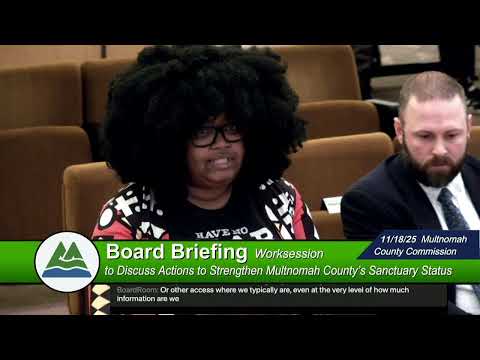
Multnomah County considers ordinance, funding and operational steps to strengthen sanctuary protections amid rising ICE activity
Summary
County staff presented a suite of options — from signage and employee training to prohibiting use of county funds for immigration enforcement and clarifying custody‑hold protocols — in response to an uptick in ICE activity. Commissioners requested sequencing, cost estimates, data‑privacy safeguards, and clearer sheriff/DA roles.
Multnomah County staff briefed commissioners on potential policy and operational measures to strengthen the county’s sanctuary commitments following a recent rise in immigration enforcement activity.
Chair introduced the session by saying community members are living in fear and that the county should explore additional options to protect residents who access county services. Garrett Pryor, senior policy adviser on infrastructure, and Salome Garrett (staff lead on engagement) summarized engagement results and framed a menu of policy options pulled from research and examples in jurisdictions such as New York City, San Francisco and Cook County, Illinois.
Staff reported a sharp increase in enforcement activity and cited an estimate of roughly 300 community members detained by ICE agents in the state during the prior month, with projections to exceed that number in the current month. Commissioners and staff agreed that the changed environment — and community reports of school lockdowns and ICE activity near county facilities — requires clearer operational guidance and public communication.
The policy menu staff presented included: clarifying detainment and custody‑hold steps and staff protocols; identifying prohibited uses of county funds and limits on county contracts (including a prohibition on entering contracts to operate immigration detention facilities); clarifying county employee and contractor expectations; improving data governance and FOIA thresholds to protect personally identifiable information; and a set of HR‑oriented actions (training, signage, leave banks, technical support for visa renewals and adjusted telework policies).
"We cast a wide net in engagement and prioritized impacted community input," Salome Garrett said, summarizing the engagement approach and the resulting desire that policy be concrete and operational.
Commissioners asked staff to prioritize actions that could have immediate impact, to provide clear low‑/mid‑/high‑cost estimates and to map which actions would best protect the largest numbers of vulnerable residents. Several commissioners also asked for clarity on law enforcement boundaries — how ICE holds differ from U.S. marshal or federal court holds, and whether county law enforcement has options when federal agents act unlawfully. Staff said sheriff’s office and county attorney coordination is ongoing; county staff committed to bringing back clearer definitions and coordination plans.
Other board requests included: explicit guidance on contractual flexibility and client assistance spending so providers can pivot quickly; a sequencing matrix showing short‑term actions (signage, training, FOIA guidance) versus longer‑term ordinance drafting; and consideration of dedicated funding for community providers as seen in other jurisdictions.
Next steps: staff will return with draft language options for a resolution and ordinance, a sequenced table of actions with estimated costs and impacts, and recommended data‑privacy safeguards and contracting guidance for rapid provider flexibility.