Get Full Government Meeting Transcripts, Videos, & Alerts Forever!
Get email alerts on the Beach Ordinance topic
No spam. Unsubscribe anytime.
Walton County adopts hybrid bonfire rules, raises vendor fees after weeks of debate
Summary
After hours of testimony and debate, Walton County commissioners adopted a revised Beach Activities Ordinance allowing both wood and propane bonfires under new safety rules and approved higher permit and vendor fees intended to fund enforcement and cleanup.
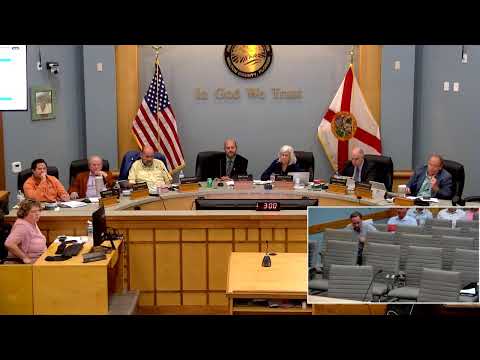
Walton County commissioners adopted a revised Beach Activities Ordinance on Nov. 24 that allows both traditional wood bonfires and propane or smokeless-style fire pits under stricter safety and cleanup requirements, and approved a tied fee schedule that increases some vendor permit costs.
The public hearing drew dozens of speakers and a lengthy staff presentation. County staff framed three options for the board: keep the existing wood-based rules with added safeguards, move to propane-only, or adopt a hybrid approach permitting either fuel type with technical conditions. Fire Marshal Sammy Sanchez told commissioners that propane reduces smoke and debris but vendors and some residents favor wood for heat and ambiance. "There's only two solutions I came up with: eliminate them totally, which I don't think anyone wants, or go to propane," Sanchez said, adding he would support whichever direction the board chose (Sammy Sanchez, Fire Marshal).
Commissioners settled on the hybrid option after extended discussion and public comment. The ordinance now requires fire pits to have solid steel bottoms, prohibits cooking apparatus attached to fire pits unless explicitly allowed, requires an attendant at all times and a fire extinguisher on site, and directs code officers to enforce cleanup and spacing rules. The board also voted to permit certain smokeless, manufacturer-brand 'smokeless- style' pits with specific installation and containment requirements after a brief reconsideration.
The commissioners separately adopted a fee resolution tied to the ordinance. The new schedule breaks out permit types (site-specific, delivery, vendor annual permit) and increases several fees — for example, some vendor/site-specific permit categories were raised substantially from prior levels, and the county established higher penalty-point values for failure to remove bonfire debris. County staff said the fee increases compensate for expanded enforcement and maintenance costs: evening code checks, UTVs and trailers, staffing and supervisory time, and equipment to respond to nightly compliance tasks.
Bonfire vendors and event operators pushed back, saying higher permit costs and stricter requirements could squeeze small local operators. "If we're going to raise fees we need a system that works and stable permitting technology," said one vendor during public comment (vendor testimony). Several commissioners urged caution about undercutting private enterprise, while others pointed to the volume of permits — staff reported roughly 10,587 bonfire-related cases so far this year — and said more enforcement resources were necessary.
What happens next: the ordinance takes effect per the county's adoption schedule and the accompanying fee resolution sets the new permit and penalty structure. Staff said they would return with administrative steps, enforcement protocols, and any implementation details required to operationalize nightly inspections, permit tracking, and the revised point/suspension system.