
Dare County public comment urges immediate reconstruction of historical groins; county staff cite permitting limits
Get AI-powered insights, summaries, and transcripts
Subscribe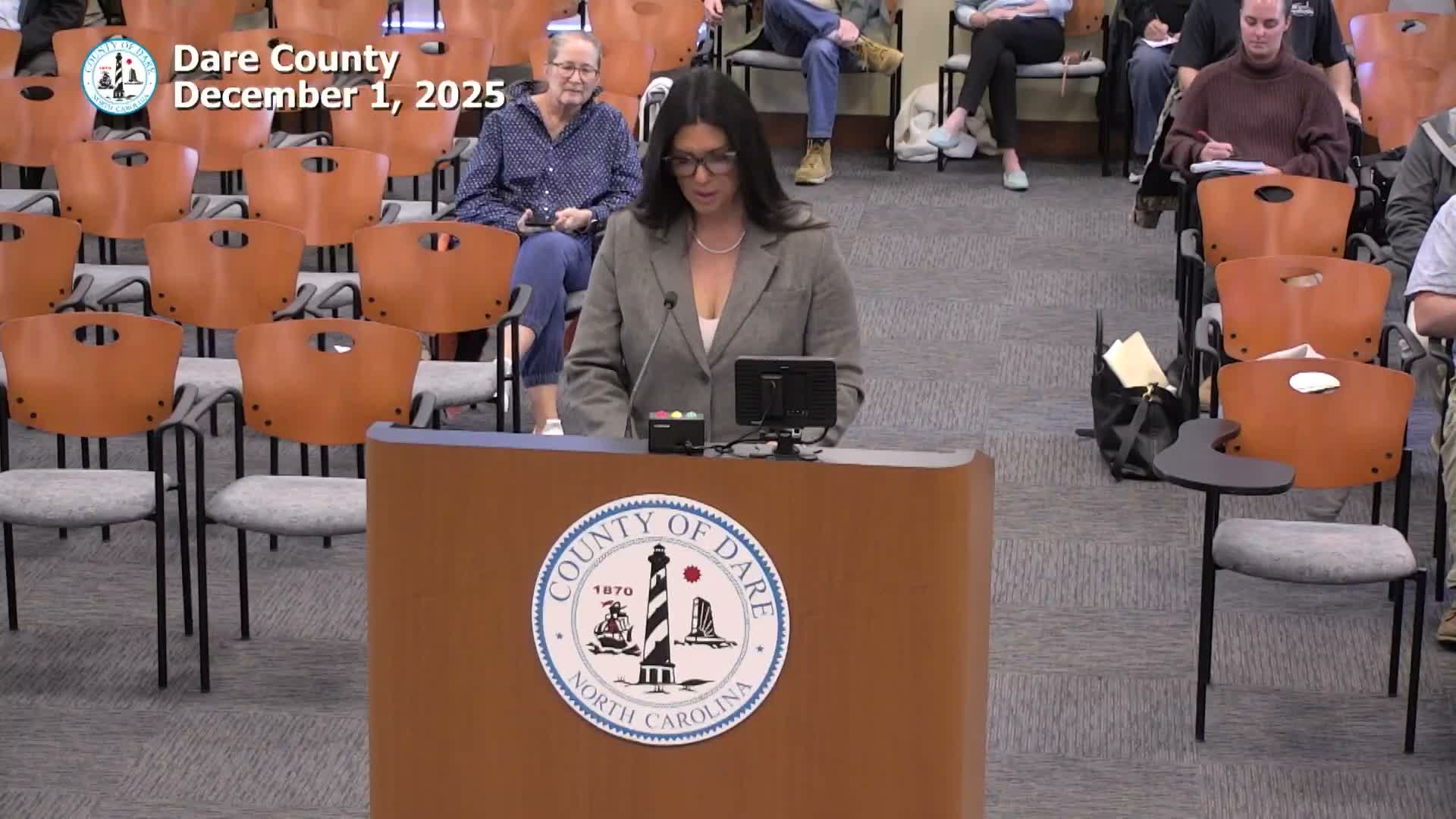
Summary
At the Dec. 1 Dare County Board of Commissioners meeting, public speakers and the chair urged action to stabilize NC Highway 12 and rebuild three historical groins; county staff and commissioners said statutory and permitting constraints and a 50% repair rule limit immediate reconstruction and that only one groin repair application is currently before state agencies.
Chair Robert L. “Bob” Woodard told the board he had written to state and federal lawmakers seeking help for severe shoreline erosion on Hatteras Island and to address persistent closures of North Carolina Highway 12.
During the public-comment period Christine Drummond urged the board to move immediately to reconstruct three Navy-built groins at the Floods (FUD) site and cited state statutes and administrative rules to back her position. “This is not debatable. It is the law,” she said, arguing that North Carolina statutes allow reconstruction of historically existing erosion-control structures and that 15A NCAC 07H authorizes emergency erosion-control measures when public infrastructure is imminently threatened.
Drummond asked the board to adopt a formal resolution establishing an administrative record, demand joint legislative hearings with DEQ, CRC, NCDOT and the National Park Service, and require 30-, 60- and 90-day environmental review steps. She warned that rebuilding only one groin — a repair plan the county has considered — would accelerate down-drift erosion and “sabotage statewide reform.”
County Manager (name not specified in the transcript) responded during commissioners’ business that the statutory ban on hardened structures is enacted by the legislature and that the Coastal Resources Commission (CRC) adopts rules to implement statute. He said the county has examined options to repair multiple groins but that a “50% rule” applies when evaluating whether a reconstruction can be treated as a repair or requires a new permit; repairing multiple long-deteriorated groins could exceed that threshold and thus not qualify for a simple repair exemption.
“Our engineers have told us that each groin starves sand to the south and that the benefit tapers,” the county manager said, summarizing technical trade-offs and permitting work the county has already done with state agencies. He added that applications are before permitting agencies and that the county is waiting to hear whether the proposed work qualifies for exemptions or requires fuller permitting.
Several commissioners acknowledged the urgency of stabilizing NC 12 and said they had met with DEQ and NCDOT. Commissioner comments reflected the tension between urgent calls for longer-term stabilization and the legal and funding constraints county staff described.
The board did not take a binding vote on reconstructing the groins during the meeting. Several public speakers and the chair asked for a formal resolution and legislative engagement; county staff said the next steps depend on state permitting determinations and potential funding availability.