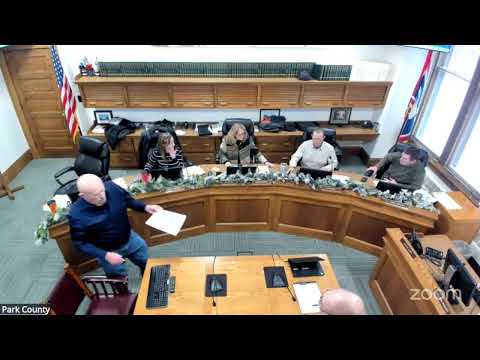
Park County health officer urges mosquito surveillance after West Nile case; volunteers and grants eyed to start pilot
Loading...
Summary
Dr. Aaron Billen briefed commissioners on West Nile virus trends and proposed a county mosquito surveillance pilot; he volunteered to manage traps next summer and staff discussed grant funding options and volunteer capacity to run five monitoring sites.
Park County's chief health officer, Dr. Aaron Billen, told commissioners the county should start a mosquito surveillance program after a neuroinvasive West Nile case this year and an increase in state cases.
"In 2025, we have had 14 reported cases of West Nile virus in the state of Wyoming," Billen said, adding that Park County had one neuroinvasive human case treated in Cody this year. He explained the surveillance workflow — CDC light traps baited with dry ice to attract Culex mosquitoes, morphological separation of Culex, pooling of captures, and PCR testing of pools by the Wyoming Department of Health laboratory in Cheyenne — and said identifying local virus presence would allow health officials to issue targeted public alerts and better inform clinical testing and vector control decisions.
Billen proposed a "walk before you run" approach and volunteered to manage trap deployment next summer, but he said sustainable monitoring would require more manpower, microscopes and funds. Alan Griffin, sanitation supervisor for the city of Powell, and Josh Shorb (Park County Weed and Pest) joined the discussion and confirmed local expertise and some existing capacity: Powell has run a trap program and has separated Culex pools to send for testing, and Weed and Pest has a microscope and seasonal staff but reduced seasonal crew levels may limit full program delivery.
Weed and Pest leadership said traps are inexpensive but personnel time is the limiting factor; they estimated an initial monitoring network of five locations across the county (Powell, Cody/Clark, a western population center, South Fork and a Matitzi area) and suggested weekly or biweekly collection as feasible. Costs for an active adulticiding and larvicide program vary; Powell staff estimated annual program costs historically ranging from about $20,000 to $35,000 depending on pesticide and treatment frequency, and that the Department of Agriculture provides emergency insect management grants that can help defray costs.
Commissioners asked whether declaring mosquitoes a county pest is required to start monitoring; Weed and Pest staff said monitoring and testing can proceed without a formal declaration, but a declaration would commit the county to surveillance/treatment obligations under state statute and would require a joint resolution with the Wyoming Weed and Pest Council and potentially additional local funding. Commissioners generally expressed support for initiating monitoring, asked staff to pursue grant funding and invited periodic updates once trapping begins.
Billen emphasized that early surveillance helps clinicians consider West Nile in patients with viral presentations and helps the public heed prevention advice. "If we know it's here, we can say to the public: take these steps," he said. County staff and Weed and Pest will pursue grant options and return with an update next fall on pilot results and funding needs.