
TWRA warns baiting raises CWD risk; commission to hold baiting rule hearing tomorrow
Get AI-powered insights, summaries, and transcripts
Subscribe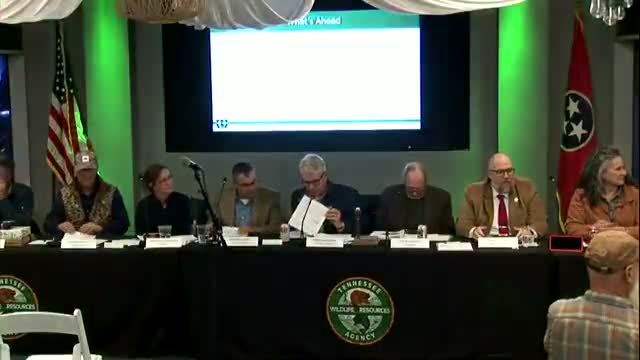
Summary
Agency experts said baiting concentrates deer, increases disease transmission and long‑term CWD prevalence; TWRA will propose continued bans on baiting/feeding inside the CWD management zone and use the zone to coordinate regulations, with a rule hearing scheduled for the following day.
TWRA staff gave a technical briefing on chronic wasting disease (CWD) and how proposed baiting policy could affect disease transmission and deer population resilience. The presentation was informational; staff said a baiting rule hearing is scheduled for the commission the following day.
Assistant Chief of Game Species Mark McBride explained CWD is caused by a prion, has no treatment or vaccine and “is 100 percent fatal.” He told commissioners that prions persist in the environment for decades and that bait sites increase both direct and indirect transmission routes by concentrating animals and creating environmental reservoirs.
McBride reviewed empirical examples and modeling showing how baiting may alter hunter behavior, reduce deer movement ranges around feeders, concentrate wildlife and increase opportunities for disease spread. He cited Mississippi and Louisiana examples where baiting legalization or bans produced complex results and warned of feeder proliferation and 'baiting wars.' TWRA’s presentation emphasized management tools the agency uses to slow prevalence growth, including limiting carcass movement, banning feed/bait inside CWD management zones, and targeted reductions in deer density.
TWRA staff outlined the existing CWD management zone established in 2023, automatic triggers that add contiguous positive counties to the zone, and exceptions (e.g., limited bird‑feeder allowances around homes). They cautioned that creating a separate no‑baiting zone outside the CWD zone could misalign rules and confuse hunters, and said such changes could discourage voluntary sampling by hunters if they fear losing baiting privileges.
Commissioners discussed political sensitivity, especially in West Tennessee, and urged agency engagement with legislators before final action. TWRA staff stressed balancing the legislature’s baiting authorization with long‑term disease management goals. The presentation concluded with agency staff preparing for a public rule hearing the following day.