Get Full Government Meeting Transcripts, Videos, & Alerts Forever!
Get email alerts on the Student Survey Equity topic
No spam. Unsubscribe anytime.
District reports high belonging scores but flags disparities and low family survey participation
Summary
Springfield Township administrators reported high student responses on key belonging measures but noted lower family participation and a 4–7 percentage‑point gap for some African American student subgroups; building-level teams will develop action plans and affinity groups will be convened for follow-up.
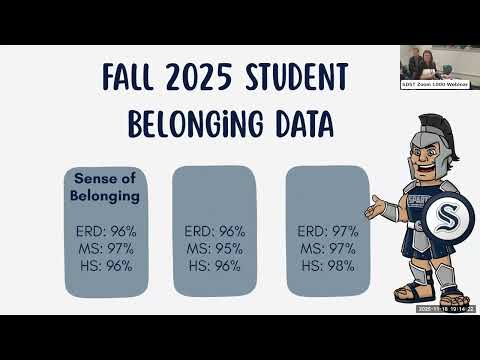
Michelle Lutz, the district director of support services, presented the results of the district’s fourth annual belonging survey (grades 3–12) at the Nov. 18 meeting, saying students reported strong feelings of belonging, access to trusted adults and safety. Lutz told the board that participation in the October administration was higher at several buildings and that the district reduced survey frequency in response to student feedback.
Lutz reported participation figures in the presentation: "82 at Erdenham, 86.4% of students at the middle school, and 73.4% of students at the high school took this survey this year," and said the district continues to see core measures in the "mid to upper nineties" for the three questions it tracks annually. She also said the district has aligned family survey questions with the student instrument to produce more comparable results.
Lutz highlighted disparities that will guide next steps: "We know right now that there is a 4 to 7 percent point gap between overall survey results and those reported by some of our African American students, especially at Erdenheim in the high school," she said, and noted building teams will disaggregate data, meet with advisory and affinity groups, and produce building‑level action plans.
Board members asked whether reducing surveys from three administrations to one would reduce data fidelity; Lutz said students found repeated administrations redundant and that participation—especially at the high school—had dipped previously. Administration said the revised approach improved participation compared with the prior year but that family participation remains an area for improvement.
Lutz also used the time to thank township commissioners and community donors who collected gift cards and food during a recent SNAP benefits crisis; those supports were distributed by school social workers to families in need.
Next steps: Disaggregated data and building action plans will be used to target outreach and interventions; leadership said results will be shared publicly on the district equity website and in the equitable practices newsletter.