Get Full Government Meeting Transcripts, Videos, & Alerts Forever!
Get email alerts on the Operating Budget topic
No spam. Unsubscribe anytime.
St. Tammany Parish Council amends proposed 2026 operating budget amid debate over cuts, COLA and dedicated funds
Summary
Councilmembers debated and amended the proposed 2026 operating budget (ordinance 7963), approving a package of reallocations and reductions that removed proposed merit/COLA increases pending insurance costs, cut funds including $600,000 from Safe Haven, and produced a series of procedural votes as members questioned whether some cuts would effectively eliminate positions.
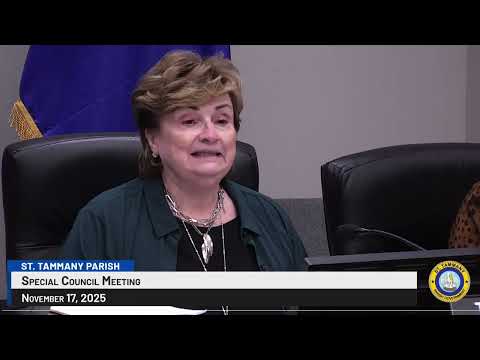
Councilmembers on the St. Tammany Parish Council spent the bulk of their meeting Tuesday on amendments to the proposed 2026 operating budget, debating cuts to personnel increases, transfers from targeted programs and whether legally dedicated fund balances can be reallocated.
Councilmember Tanner introduced the primary amendment, saying the measure removes the proposed merit and cost-of-living (COLA) increases from department budgets until insurance-cost estimates are known. "I haven't a clue" how the parish will absorb a projected 2027 shortfall, Tanner said, and proposed removing roughly $1,000,000 in merit/COLA amounts and specific line items to reduce expenditures.
Tanner itemized changes included removing $600,000 from the Safe Haven program while preserving funds for rent and grants; deleting $50,000 from council professional services; eliminating a $120,000 vehicle for the CAO; cutting a $450,000 sewer study in environmental services; shifting $125,000 from the fairgrounds master plan; and budgeting $356,000 for litigation expenses the parish expects will not be covered by insurance.
Annie Perkins in finance cautioned that many line-item reductions do not translate dollar-for-dollar into general-fund savings because the parish uses cost-allocation across funds. "The net impact to the general fund is only $1,900," Perkins said after the allocation calculations were applied.
Public commenters pressed council priorities. A commenter who identified himself as Glenn urged the council to review balances in multiple restricted funds — including public-works transfers, hotel-motel (CRT) revenue, coroner and law-enforcement witness funds — which he estimated at "almost $41,000,000" in cash or cash equivalents and suggested some lawfully reallocated amounts might shore up criminal-justice shortfalls. Perkins replied that many of those funds are statutorily dedicated and could not be redirected without voter approval or state legislative action.
Michael Henderson, a separate public commenter, urged changing the minimum-fund-balance policy from one year to three months to free an estimated $5.6 million for state-mandated funds. Perkins and other finance staff said minimum balances are driven by cash-flow timing — ad valorem revenue is collected late in the year and may not be available when needed — and by grant-reimbursement requirements.
Councilmember Laughlin proposed a package of reductions that would return roughly $363,612 to the general fund and produce an overall savings the administration estimated near $515,611 before allocations. Councilmember Seiden later moved to amend Laughlin's amendment to add back $97,000 to the parish president's office and restore cuts to development; the council approved that amendment on a roll call of 8–5 with one absence.
Members repeatedly debated whether reductions were cuts to 'funding' only or whether departments would have to remove positions if salary line items were eliminated. Legal counsel and finance staff explained the amendment reduced funding; because some affected positions are paid from multiple funds through cost-allocation, the practical effect could be elimination of a position if a department lacks alternative lines to cover payroll.
Several procedural motions and votes followed as the council navigated Robert's Rules for amendments, amendments to amendments, and motions to vacate (reconsider) earlier votes. Early in the session the clerk recorded one vote as "The motion is unanimous with 2 absent" on a set of amendments; later votes amended or vacated earlier changes, with roll-call tallies recorded in the meeting record.
The council did not adopt a final operating ordinance on the floor during the excerpted discussion; instead, members advanced and reshaped amendments and moved to introduce companion capital transfers for separate consideration.
The council's next procedural step is formal introduction and subsequent votes on the ordinance as amended; administration said it will provide updated insurance and cash-flow estimates before the council considers final adoption.