
Rapid City presents I‑90 Corridor climate plan, targets 31% emissions cut by 2050
Get AI-powered insights, summaries, and transcripts
Subscribe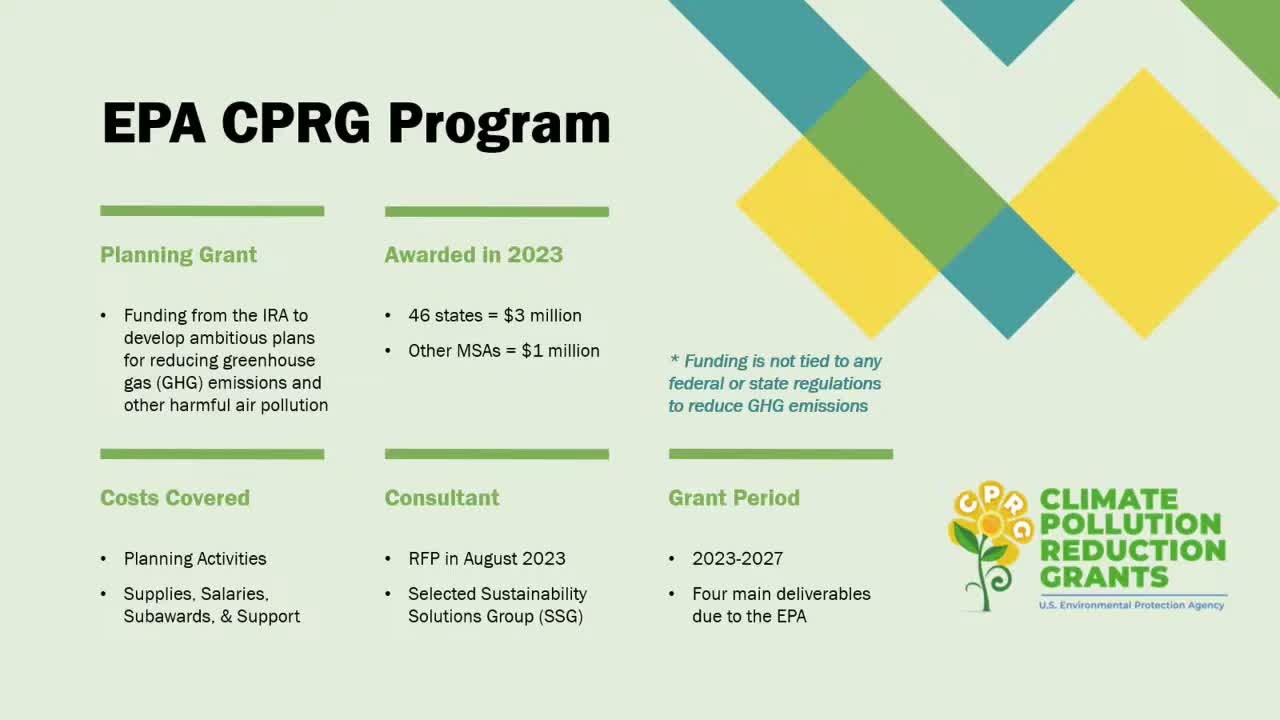
Summary
LaSanne Zeller presented the I‑90 Corridor climate action plan—developed with a $1,000,000 EPA planning grant—showing corridor emissions of about 3.4 million metric tons CO2e and recommending a realistic 31% reduction scenario that would lower per‑capita emissions to roughly 9.3 by 2050.
LaSanne Zeller, sustainability and stewardship program development manager in Rapid City’s Public Works Department, presented a comprehensive I‑90 Corridor climate action plan Tuesday that models greenhouse‑gas reductions for a seven‑community region stretching roughly from Spearfish to Box Elder.
The plan, funded by a four‑year, $1,000,000 EPA planning grant awarded in 2023, expands Rapid City’s earlier inventory to cover the I‑90 Corridor (including Mead and Pennington counties). Zeller said the corridor produced about 3,400,000 metric tons of carbon dioxide equivalent in 2021 and estimated per‑capita emissions at about 23.4; Rapid City alone was about 19 per person in the same baseline year.
The plan models three scenarios and recommends a mid‑range target: a 31% reduction in total emissions by 2050. According to Zeller, that outcome would reduce per‑capita emissions to about 9.3 by 2050 while accounting for projected population growth from roughly 146,000 in 2021 to about 220,000 by 2050. Zeller said that, under a business‑as‑usual trajectory, per‑capita emissions would decline somewhat but total emissions would rise as population increases.
Zeller described the primary drivers of the modeled savings: transitioning to low‑carbon concrete and cement and electrification of personal vehicles. She referenced the South Dakota EV fast‑charging plan’s assumption that by 2035 about half of new car sales will be electric, and said electrifying transportation was a larger near‑term contributor to emissions savings in the model than she had expected. She also said staff used local task‑force input, dozens of stakeholder interviews and community engagement—including an online questionnaire in which about 86% of respondents said reducing climate pollution was at least somewhat important—to shape the recommended measures.
Staff and consultants developed a suite of low‑carbon measures organized by sector—energy generation, industrial processes, transportation, and building heating/cooling—and produced scenario projections (10%, 31%, 58%). Zeller said the 31% scenario was chosen as “realistic but challenging,” while the 58% case would require much more aggressive actions.
Zeller highlighted near‑term deliverables and next steps: the draft comprehensive plan will be submitted to the EPA on December 1, a longer public presentation by consultants is scheduled for December 11 at 1 p.m. (Zoom), and ongoing planning engagement will continue through 2026 with a final deliverable due in August 2027.
“Many of the measures we modeled create co‑benefits,” Zeller said, pointing to improved air quality, public‑health gains, energy‑cost savings and local green‑job opportunities. She acknowledged limits to local authority on certain policies—specifically state utility rules on net‑metering that make selling rooftop solar back to the grid less financially attractive in South Dakota—but said the corridor plan can identify opportunities the region can pursue collectively.
The council moved to acknowledge the presentation by voice vote; no formal policy action was taken at the meeting. The plan will be posted online and staff said they will host additional public meetings across the corridor in coming months.