Get Full Government Meeting Transcripts, Videos, & Alerts Forever!
Get email alerts on the Rental Assistance topic
No spam. Unsubscribe anytime.
Glendale council adopts rental‑assistance policy, votes to seek waiver to redirect legal‑services funds to aid
Summary
The Glendale City Council approved policies to launch the Glendale Rental Assistance and Stability Program (GRASP), authorized staff to implement the pilot, and voted to request a 20% attorney‑service waiver from LA CASA so roughly $300,000 could be redirected to direct rental assistance. Staff estimates direct assistance could be about $1.2 million and serve roughly 100–150 households.
The Glendale City Council on Dec. 2 approved policies and procedures to launch the Glendale Rental Assistance and Stability Program, a three‑arm pilot intended to prevent evictions and stabilize households.
Staff described GRASP as three parts: emergency assistance to cover back rent or prevent utility shutoffs, income support to fill ongoing gaps between income and rent, and a special assistance arm for one‑time, housing‑stabilizing interventions such as car repairs. Housing Supervisor Sipan Zadorian told the council the program would open in February or March 2026 after finalizing operations, hiring two caseworkers and an intake worker, and completing outreach and software setup.
Zadorian said program eligibility will require renters be Glendale residents with incomes at or below 80% of area median income and a documented housing hardship (eviction notice, job loss, medical bills). Applicants will be split into ‘critical’ cases (imminent eviction or utility shutoff) and ‘noncritical’ cases and ranked with a points rubric based on income level, rent burden and vulnerability indicators. Staff recommended a two‑week initial open application followed by referrals from partner agencies and a 14‑day verification goal once applicants respond with documentation.
Council members pressed staff on several operational points: whether vulnerability points stack (for example, seniors with disabilities), how the rubric aligns with homelessness data, estimated caseloads, and how the program handles tenants already subject to unlawful detainer filings. Zadorian said the city has asked LA CASA for guidance on whether to intervene once a case is already deep in eviction proceedings and that the program’s aim is to capture households earlier in the process.
Funding and attorney‑service waiver
The program is funded through LA CASA (Los Angeles County Affordable Housing Solutions Agency) allocations. Staff said council previously authorized $1.1 million in LA CASA funds and $300,000 was allocated to an existing program; with a waiver of the LA CASA 20% attorney‑service requirement staff estimates direct assistance could be about $1.2 million from the LA CASA pool and the total funding available for the program would be roughly $2.1 million when combined with other sources. The LA CASA attorney‑service requirement was cited at about $421,000; staff said a waiver would allow approximately $300,000 to be redirected to direct assistance while retaining roughly $84,000–$87,000 for limited legal‑education and document review services.
Several council members said they prefer directing as much money as possible to direct assistance rather than full attorney representation; Mayor Najarian and others warned that bringing attorneys into eviction cases can extend litigation and might not restore tenancies if landlords refuse to accept returning tenants. Staff and the mayor discussed mediation and landlord engagement as operational tools.
Targeting, staffing and reporting
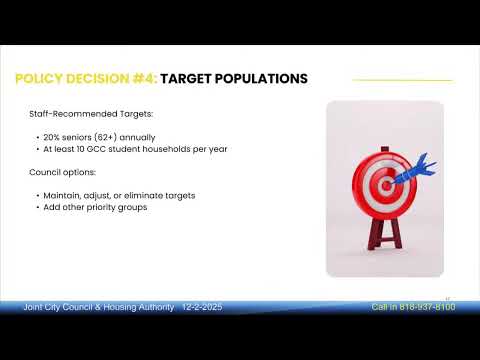
The council gave staff direction on the program design. Members agreed to allow households up to 80% AMI to apply while aligning points to favor households at 50% AMI and below. The council set a target to aim for at least 30% of funds to serve seniors 62 and older (up from staff’s draft 20%), agreed to add points for children with a proposed cap (three children), and favored hiring hourly staff initially rather than creating permanent full‑time positions. Staff said they will return with more details and recommended quarterly public reports and periodic memos on program performance.
What happens next
Council moved, seconded and recorded unanimous support to adopt the GRASP policy manual, authorize implementation and request the LA CASA waiver. Staff will finalize operating procedures, begin hiring, and return with implementation details and periodic progress reports.