Get email alerts on the Building And Fire Codes topic
No spam. Unsubscribe anytime.
Denison council hears plan to adopt 2024 building and fire codes, proposes 2026 effective date
Summary
City staff proposed adopting the 2024 International Codes with North Central Texas Council of Governments amendments, with a Jan. 1, 2026 effective date and a soft transition for energy rules through March 1, 2026; no adoption vote was taken tonight.
Denison City Council members heard a detailed presentation Nov. 17 on proposed updates to the city’s building and fire codes, including a staff recommendation to adopt the 2024 International Codes with regional amendments developed by the North Central Texas Council of Governments (NCTCOG) and a proposed effective date of Jan. 1, 2026.
Kirk Kern, presenting the project update for city staff, said the proposal would align Denison with neighboring North Texas cities and help protect the city’s Building Code Effectiveness Grading Schedule rating. “Staff is proposing to adopt the 2024 codes with NCTCOG amendments with an effective date of 01/01/2026,” Kern said during the presentation.
Why it matters: Kern said bringing Denison up to the 2024 code cycle addresses safety gaps, maintains access to inspector certification and preserves the city’s ISO/BCEGS insurance rating, which can affect premiums for homeowners and businesses.
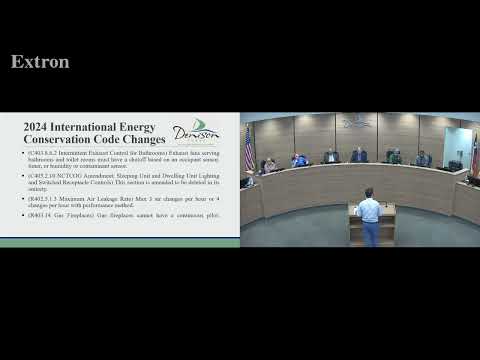
Key provisions and changes highlighted by staff include: - Energy code transition: staff proposed a soft transition from Jan. 1–March 1, 2026, with formal enforcement of the new energy code beginning March 1 to help permit applicants and the permitting staff adjust to new uniform energy‑reporting forms. - Residential updates: clearer smoke‑alarm placement tied to manufacturers’ instructions; required blocking for future grab bars in tubs and showers to support aging‑in‑place retrofits; upgraded fire‑separation details for shared laundry and storage areas in multiunit buildings. - Commercial changes: an added one‑hour fire method linked to UL listings, new guidance for insulated metal panels and expanded carbon monoxide detection where CO‑producing devices are present. - Fire‑safety and emergency response: proposed changes address lithium‑ion battery storage and larger warehouse risks, emergency responder radio testing inside large structures (ERCES), retroactive carbon monoxide detector requirements for certain hotels and apartments, and lower thresholds for required fire suppression systems.
On lithium‑ion batteries, the presenter identified in the transcript as Harlan warned about the difficulty of suppressing thermal‑runaway fires in large, unprotected battery storage areas. “There’s almost no way for us as a department to put those out,” Harlan said, describing why the code adds storage control, suppression and permitting requirements.
What council did: the item was presented as a project update and staff said they will post a proposed code adoption package and a list of major changes on the city website; Council did not vote to adopt the codes tonight.
What’s next: staff will post the proposed adoption materials online and continue outreach to builders and inspectors; if the council later schedules a formal adoption item, the council would need to consider the ordinance and a formal vote. The presentation included multiple numeric thresholds and timing proposals (for example, the suggested 6,000‑square‑foot threshold for suppression and a 12‑foot trigger for high‑piled storage permits) that staff said should be reviewed by council before final action.
AI generated
The text on this page is AI generated. Summaries, highlights, analysis, and video transcripts are all produced from the original source material.
AI can make mistakes, so if you spot one, and we will fix it for everyone.
Note: the source content is unaltered by us. Any content source we link to, be it a video, an audio recording, or a document, is presented exactly as its publisher released it. That publisher is usually a government body, sometimes an individual official or another organisation.