Get Full Government Meeting Transcripts, Videos, & Alerts Forever!
Get email alerts on the Environmental Regulation And Development topic
No spam. Unsubscribe anytime.
Select Board debates tougher earth-removal rules and whether to preempt data centers
Summary
Board members discussed tightening the earth-removal bylaw (fees, performance bonds, remote monitoring and peer review) and considered whether to craft a bylaw to limit high-resource users such as data centers, with members split between a preemptive ban and requiring enhanced reviews.
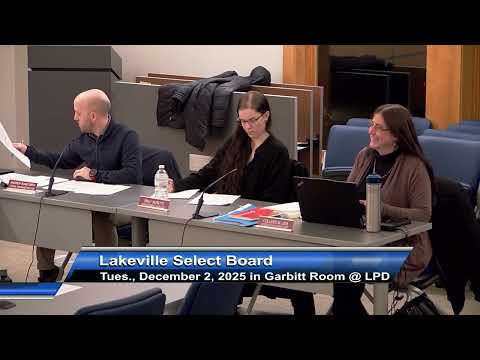
Select Board members spent a substantial portion of their Dec. 2 meeting debating updates to Lakeville's earth-removal bylaw and whether the town should adopt a bylaw to limit so-called 'overconsumption' by large industrial users, including data centers.
A Select Board member said the current earth-removal bylaw (last revised Nov. 8, 2021) contains low administrative fees ($200 per acre and $0.15 per cubic yard) and does not reflect newer monitoring technologies. The member proposed tightening performance-bond requirements, increasing fees, and using remote inspection (drones) and peer-review engineering (paid via a 53G account) so applicants bear review costs.
Town staff and other members supported a tiered, checklist-based approach that would scale review requirements with project size and environmental sensitivity. One member urged creating a clear checklist so permit levels are objective: "If you check box 1, 2 and 5, then you're at this level; if you check 1, 2, 3, 4 and 5, then you're at this level." Another member recommended using 53G funds to pay for peer review and construction administration so the town would not incur staffing burdens.
On larger industrial users, a member proposed drafting a bylaw addressing overconsumption of scarce natural resources — water and energy — and said data centers can require “millions of gallons” and have high energy use that could raise costs for residents. Other members cautioned against a preemptive ban, noting zoning and existing utility-capacity reviews might be sufficient and warning that proactive prohibitions could deter commercial investment. One member referenced an out-of-state legal case in which a municipality was sued after denying a project and lost.
The board agreed to continue the discussion and directed staff to compile comparative language from other towns, cost/fee options, and stakeholder input (planning, conservation, DPW) to prepare potential policy or bylaw language for future consideration.