Get Full Government Meeting Transcripts, Videos, & Alerts Forever!
Get email alerts on the Duke Clean Energy Connection topic
No spam. Unsubscribe anytime.
Largo commissioners weigh staying in Duke Energys Clean Energy Connection amid uncertain payback
Summary
City staff reported the Duke Clean Energy Connection subscription has cost Largo about $152,000 cumulatively (recently revised to ~$135,000), helps meet the Ready for 100 offset target, and is projected to reach net-neutral around program year 12; commissioners asked for the original projections and asked Duke to appear before a vote next year.
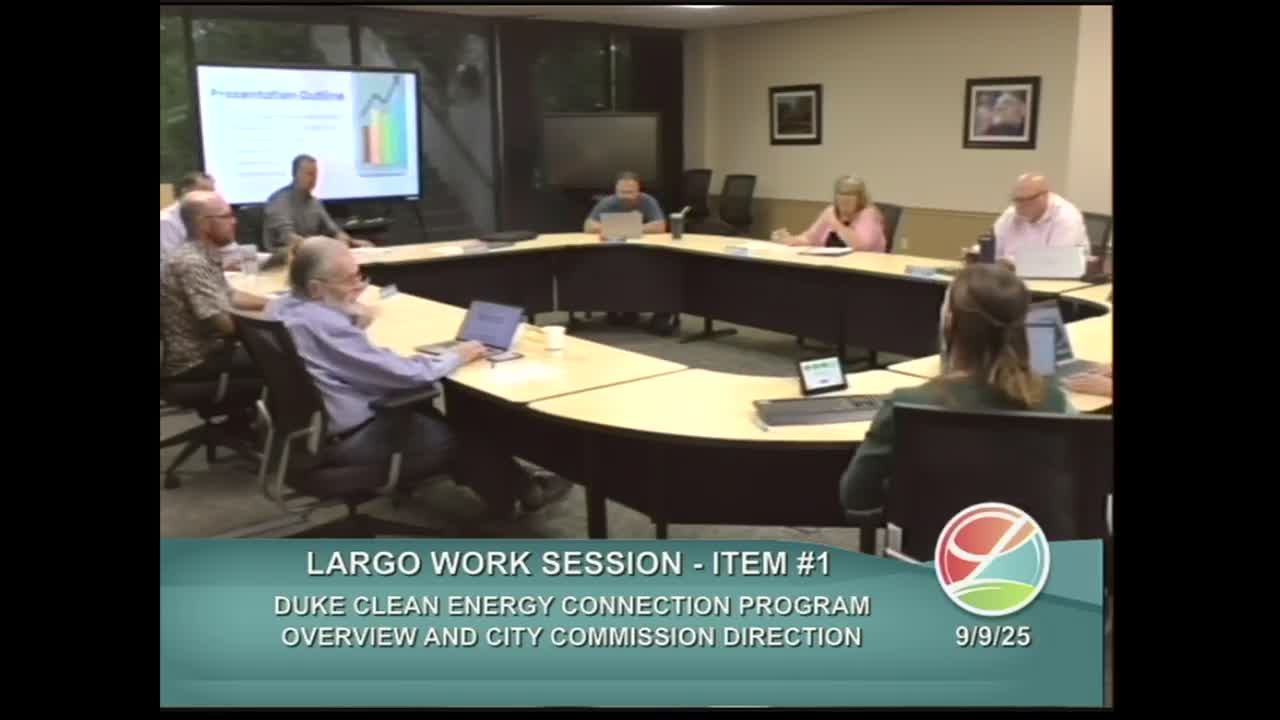
City of Largo staff told the commission on Sept. 9 that the city's participation in Duke Energy's Clean Energy Connection (CEC) subscription has helped accelerate progress toward the city's Ready for 100 municipal target but carries financial uncertainty.
Staff presentation: Staff members said Largo enrolled 55% of municipal accounts in the CEC and currently has 11 accounts subscribed. The city has paid a cumulative net of about $152,000 into the CEC since enrollment; staff updated that figure to roughly $135,000 after higher-than-expected August generation. Staff said the subscription model combines a flat per-kilowatt subscription fee with a per‑kWh credit that increases 1.5% annually, and that the program term is 33 years with a modeled break-even around program year 12.
Why it matters: Commissioners pressed staff on whether the subscription model delivers the best value for residents. Some members argued the city's on-site energy-efficiency work (HVAC upgrades, sensors and account-billing changes) produced direct savings of about $300,000 and that buying or owning local solar could produce stronger long‑term financial returns if usable space were available. Others said the subscription helped the city advance an adopted policy goal and that leaving today would lock in the city's sunk investment.
Numbers and risks: Staff detailed a Duke-provided modeling range that shows cumulative net payments through year 10 in the low hundreds of thousands and long-term estimated cumulative returns by year 33 between about $771,000 and $1.5 million. Staff cautioned these are ranges and noted two early factors that depressed generation: Hurricane Ian damaged a major array and COVID-era supply-chain and contractor-certification delays. Commissioners asked how production shortfalls, future Duke rate increases and the static subscription fee interact with the fixed credit amount.
Next steps: The commission asked staff to retrieve the original enrollment projections from four years ago and requested a future regular meeting item that would include a Duke representative so commissioners can question program assumptions directly. Staff recommended monitoring the performance now that all 10 arrays are online and returning in a year with updated projections and clear performance expectations before taking formal action.
Quotes from the session: "There's no legal requirement — it's just a target," said a staff presenter describing Ready for 100. A commissioner said bluntly, "I don't trust Duke Energy," noting the projections come from the utility. Staff responded that renewable energy credits and generation allocations are subject to federal reporting and certificate systems designed to avoid double-counting.
What the commission recorded: Commissioners asked staff to bring the original CEC projections and to schedule the participation question for a regular meeting vote with a Duke representative present. No formal vote on unenrollment occurred at the work session.