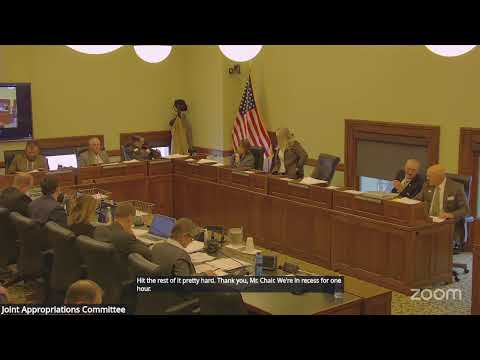
Wyoming education chief outlines six priorities; lawmakers press over charter board pay
Loading...
Summary
Superintendent Megan Degenfelder told the Joint Appropriations Committee her Department of Education budget centers on six priorities — parental transparency, CTE, civics, reduced bureaucracy, teacher supports and literacy — and requested exception funding for IT, charter authorizing board operations and a state literacy position. Lawmakers pressed the department to revise an executive director pay recommendation for the charter authorizing board.
Megan Degenfelder, Wyoming’s state superintendent of public instruction, presented the Department of Education’s (agency 206) budget and said the department’s strategic plan focuses on six priorities: parental empowerment and curriculum transparency, career and technical education, patriotism and civics, reducing bureaucracy, supporting teachers, and early literacy. “I am extremely proud of the work of the department of education over the last 2 years,” she said, citing modest gains on state assessments: English language arts and science have returned to pre‑pandemic levels and math is “0.4 away” from pre‑pandemic achievement.
Degenfelder walked the committee through the agency’s exception requests. Priority items include IT replacement (65 laptops and associated software), creation of a separate budget unit for the state‑authorized charter school authorizing board, and a state literacy position to manage both federal grant duties and state statutory responsibilities. She told the committee 26 of 48 school districts participate in a curriculum transparency initiative and that the department has launched a civics portal with University of Wyoming resources and museum videos for statewide access.
A point of contention was the charter authorizing board’s operating unit and the executive director’s salary. Degenfelder said the board requested a separate budget unit and noted the board is autonomous: WDE provides administrative support but does not direct board decisions. She told the committee she opposes an executive director salary “being far higher than comparable state positions,” and asked that, if the Joint Appropriations Committee follows the governor’s recommendation, the special revenue amount be reduced by roughly $80,000 to align with comparable state roles.
Trent Carroll, of the Wyoming Department of Education, described the department’s salary comparables analysis and said there are few exact matches for the executive director role; the estimate drew on similar A&I‑classified positions, a comparable WDE administrative role and district superintendents. Carroll also noted the number of state charter applications is likely to increase after the removal of the cap, though he said the department does not yet know how many applications the March window will produce.
On literacy, Degenfelder and department staff described a turnover in federal literacy funding: an earlier federal grant had been paused then partially restored at a lower level. Because federal staff cannot perform certain state statutory duties, the department requested a dedicated state literacy position to supervise the federal grant and administer the state’s statutory literacy work. Degenfelder said a joint education committee bill also includes an additional literacy position.
The presentation included several clarifying details for the committee: the department reports 131 employees in its budget request, has implemented project‑management software to track workloads, and has piloted work‑based and project‑based learning supports for CTE. Degenfelder said the department will forward curriculum materials, civics portal links and a one‑pager on literacy efforts to committee members.
The committee did not take a vote during the hearing; members asked for follow‑up materials and detailed budget pages for specific exception requests.