Get Full Government Meeting Transcripts, Videos, & Alerts Forever!
Get email alerts on the Redistricting topic
No spam. Unsubscribe anytime.
Residents urge board to delay or choose lower-impact redistricting option; Centennial Lane families oppose moving polygons
Summary
At a long public hearing the evening of Nov. 6, dozens of speakers — many from Centennial Lane and Columbia-area schools — asked the Howard County Board of Education either to adopt a low-impact plan (concept 4 or 5) or to delay redistricting until data and new-housing impacts are validated; speakers raised transportation cost, community stability and data-timing concerns.
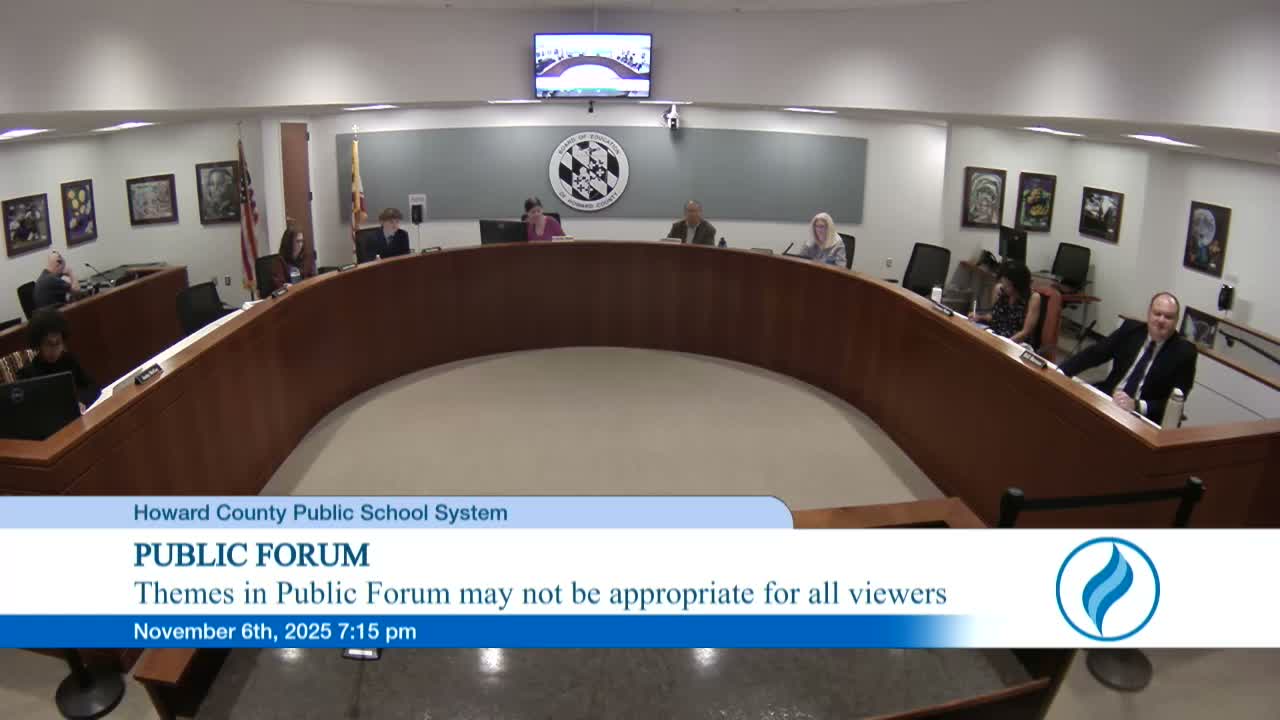
A packed redistricting public hearing at the Howard County Board of Education meeting on Nov. 6 focused on competing boundary proposals for the county’s Western Columbia and Centennial-area schools.
Multiple families, students and PTA representatives from Centennial Lane Elementary School and adjacent neighborhoods urged the board not to reassign polygons that would send walkers to distant schools. They argued that the lived experience inside Centennial Lane (classroom space, cafeteria flow, band room, and portable usage) does not match the high utilization figure quoted on maps and that moving small groups of students would fracture contiguous neighborhoods and force new bus tiers that add recurring transportation costs. Several speakers asked the board to adopt concept 4 or 5 (which move far fewer students) or to pause the decision until more accurate student counts and housing-development enrollment impacts are verified.
Parents and community leaders from Bryant Woods, Swansfield, Clemens Crossing and Beaverbrook also testified in favor of plans they said would minimize disruption and lower operating costs. Some speakers warned that large-scale moves (concepts 1 or 2) would cost the district hundreds of thousands of dollars a year in transportation and could force cuts to programs; others argued those plans would re-segregate schools by concentrating high-need students in a small number of buildings.
Multiple speakers said new concepts were posted late in the process (Oct. 29) and that affected neighborhoods thus had limited time to prepare public comments; several urged the board to slow the process to ensure equitable engagement. Administration and board members acknowledged the timing concerns and discussed the trade-offs of a narrow scope versus a broader redistricting footprint.
A sampling of testimony: - Alisa Yeh, a Centennial High junior, asked the board to protect contiguous neighborhoods and warned that moving her neighborhood’s polygon would sever established K–12 feeder patterns and traditions. - Parents and PTA leaders from Centennial Lane said the school does not "feel" overcrowded in daily experience and asked the board to consider portable capacity and short-term fixes. - Speakers from Beaverbrook and Clemens Crossing urged adoption of concept 4 because it moves fewer students and keeps neighborhood feeds intact.
What happens next: The board will consider the public testimony and make a final redistricting decision in a later meeting (the transcript indicates final action is scheduled in late November or December per the board’s calendar). Some community leaders asked the board to delay a decision until next year to let updated housing data and enrollment projections mature. The transcript shows the hearing included 42 registered speakers and more than an hour of public testimony.
No immediate boundary decisions were recorded during the Nov. 6 session; the hearing will inform the board’s final vote in the prescribed timeframe.