Consultant: Claremore scores 7.1 on new fiscal health model; officials told FEMA reimbursements still pending
Loading...
Summary
A consultant'using a new "performator" scoring model told the Claremore City Council the city's overall fiscal score is about 7.1, highlighting low unassigned reserves and delayed FEMA reimbursements; councilors and staff said they will monitor reserves and use the tool annually.
Frank, a consultant and the presenter of the city's "performator" financial model, told the Claremore City Council that the city's overall fiscal health score is about 7.1 and that the last few years have been distorted by one-time events such as federal COVID-era aid and recent tornado recovery.
Frank said the model reduces audited financial statements into grouped ratios that measure "position, performance and capability," and that the 7.1 aggregate indicates a generally healthy city but one affected by extraordinary temporary funding and disaster-related spending. "The bad news is I couldn't have picked a worse 3 or 4 year period to analyze," he said, noting CARES and ARPA funds and tornado-related outlays have changed the short-term picture.
The consultant flagged the city's unassigned general fund balance at about 2.1 percent of annual revenue (roughly $441,000) and an assigned fund balance of about $4.5 million. He told the council he would generally like to see unassigned reserves closer to 10 percent of annual revenue. Frank also described Claremore's cash-flow and debt metrics as strong in some respects, saying the city currently has solid quick ratios and debt-service coverage but that certain performance ratios were buoyed by one-time federal funds.
On sales tax and borrowing, Frank noted Claremore's 3-cent sales tax is low for communities its size and said the city still has capacity to issue GEO debt, subject in Oklahoma to voter approval for levy-backed property tax repayment. "You've got a 3¢ sales tax. That's the lowest literally of any community your size in the state," he said, adding the GEO mechanism gives the city an option that requires voter approval.
Councilors and staff thanked Frank for a presentation they said will help explain the city's fiscal condition to the public. The city manager (unnamed in the transcript) said staff will use the model annually to track changes and that rebuilding reserves is a priority. On disaster recovery funding, Frank said Claremore is still awaiting reimbursement from FEMA and cited figures in the millions: "we're still owed about $12,000,000," he said, and later referenced figures nearer $17,000,000 as timing and partial payments vary.
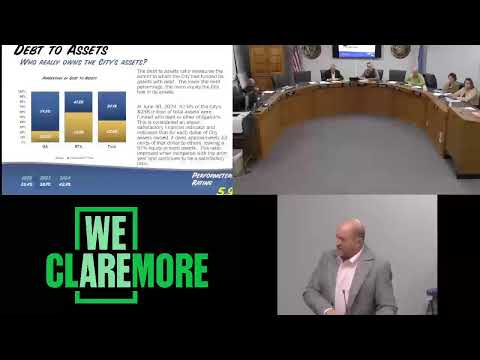
The presentation included slide-by-slide commentary on capital-asset condition (about half of useful life remaining), pension and other-post-employment-benefit funding approaches, and the impact of recent bond issuances on the debt-to-asset ratio. When councilors asked about an apparent increase in the debt-to-asset ratio after issuance of a roughly $28 million OWRB bond, Frank and staff explained that issuing bonds before spending the proceeds can temporarily raise that ratio until capital projects are constructed and assets recorded.
The council did not take any immediate fiscal-policy votes at the meeting; members directed staff to continue monitoring reimbursements and reserve levels and to present the model annually with updated audited financials. The presentation concluded with the mayor and council thanking the presenter and staff for the information.