Get Full Government Meeting Transcripts, Videos, & Alerts Forever!
Get email alerts on the Parks And Recreation topic
No spam. Unsubscribe anytime.
Concord meeting draws spirited debate over proposed Martin Park bike park; environmental review, notifications and site choice remain unresolved
Summary
City Parks & Recreation presented a concept for a volunteer-managed mountain-bike park at Russell Martin Park; supporters highlighted youth safety and stewardship while abutters raised concerns about inadequate notice, wildlife impacts, wetlands, liability and the appropriateness of this specific site. The city said environmental review and further site study are required before any design.
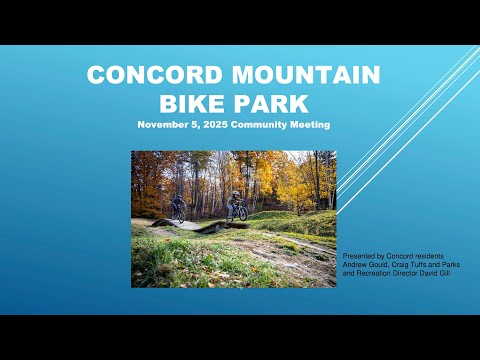
Concord’s Parks & Recreation staff on Tuesday presented a concept for a mountain-bike park at Russell Martin Park and heard roughly two hours of public comments that ranged from guarded support to firm opposition over the location and process.
David, a Parks & Recreation staffer, opened the meeting by apologizing after some nearby residents said they did not receive notice of an earlier September session and said the city held the session to gather additional feedback before pursuing any design work. "We're redoing the meeting," David said, and emphasized that environmental review and agency clearances would be required before any construction.
Supporters — including local chapter volunteers and parents — described the park as a small, wooded facility for riders of all ages and skill levels featuring dirt features, wooden elements and a pump track, managed in large part by volunteers. Mike Davern, a volunteer from Keene with experience building a similar park, described a stewardship model in which local riders carry out day-to-day maintenance and occasional volunteer workdays, saying the city did not have to shoulder routine upkeep.
Opponents and nearby residents questioned the choice of Russell Martin Park for a destination facility. Ian West, who lives on Ironworks Road, said many abutters "did not receive notifications" and said linking the bike-park proposal to solutions for homelessness was "disingenuous." Multiple neighbors raised environmental concerns, including vernal pools and the presence of pileated woodpeckers and other sensitive habitat, and asked how the project would avoid wetlands and nesting areas.
City staff responded that the proposed bike-park envelope is a roughly 1.4-acre triangular area adjacent to existing trails and a kiosk, and that the current discussion is concept-level. "Even if city council says move forward, there's no design — there's no environmental review that has to happen," David said, adding that any site selected for design would require a deeper environmental review and agency input before construction.
Cost and funding were discussed at a high level. Presenters said they plan to fundraise and seek donated materials and volunteer labor rather than ask the city for construction funds. The transcript records two cost figures as stated by presenters: an example figure of about $20,000 for a half-acre installation cited when showing comparable parks, and a larger preliminary figure read aloud by a presenter; the latter number in the transcript appears inconsistent and will need clarification in later documents.
Residents also pressed officials on safety, policing and liability. Several abutters said informal trails and "pump line" features already exist and worried that formalizing a destination park would increase trespass, short-cutting across private yards and demands on police. Supporters responded that established, stewarded facilities tend to reduce rogue trail-building and unwanted uses, pointing to examples where vandalism diminished after a managed facility opened.
Throughout the meeting, presenters repeatedly said the project is preliminary. David told the room the city would post maps and the list of sites studied on the Parks & Recreation website and invited residents to suggest alternate locations. He provided a contact email (dgill@concordnh.gov) and directed residents to recreation@concordnh for submissions.
Next steps: city staff will collect public comments, consider alternate sites raised by neighbors and, if one or two candidate sites remain, proceed to environmental review and agency consultations before any design or construction decisions. No formal votes or approvals were taken at the meeting.