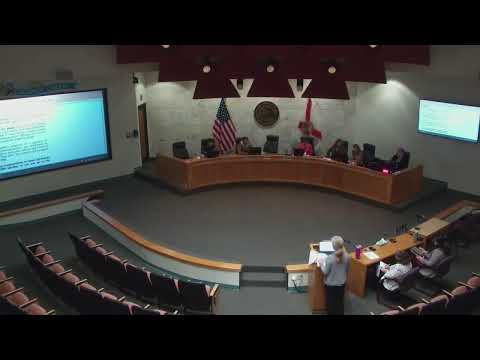
Coconut Creek holds ethics workshop for commissioners covering conflicts, public records and social media

City of Coconut Creek Commission · November 20, 2025

Loading...

AI-Generated Content: All content on this page was generated by AI to highlight key points from the meeting. For complete details and context, we recommend watching the full video. so we can fix them.

Summary

City attorneys led a workshop Nov. 19, 2025, reminding Coconut Creek commissioners of state and Broward County ethics obligations, training and filing deadlines, rules on gifts and lobbyists, sunshine and public-records obligations, and social-media limits.

Cassandra "Cassie" Harvey, assistant city attorney for Coconut Creek, led a workshop-style ethics training on Nov. 19, 2025, telling the commission it must “complete 4 hours of ethics training, 2 of which must be done in an interactive setting,” and that the certification for this session must be posted online by 01/30/2026. City Attorney Terrell Pyburn introduced the session and noted that Harvey was assisted by Laura Vargas Gallardo.

The two-hour session reviewed state statutes and Broward County rules that together govern commissioners’ conduct, conflicts, gifts and lobbyist interactions. Harvey cited Florida statute language prohibiting use of official position or nonpublic information for private gain (including references to Section 112.3136 and related subsections) and summarized a recent Broward OIG memorandum (OIG25010M) urging better training compliance; she said the clerk’s office will send reminders and offer hands-on help with filings.

Presenters used brief news clips and hypotheticals to illustrate misuse-of-position concerns — from asking a chief of police for a preferred ride to soliciting extra sandbags during an emergency — and repeatedly emphasized public perception. Harvey explained Koontz v. St. Johns River Water Management District as an example of an "illegal exaction," where a government condition must have a reasonable nexus to a proposed development’s impacts.

On gifts and fundraising, officials were told to follow both state and county rules: file the Form 1 (statement of financial interest) annually by July 1, file a Form 8B memorandum of voting conflict within 15 days after a disqualifying vote, and disclose gifts via Form 9 when required. Harvey said commissioners must report event tickets and other gifts over $100 unless the tickets are connected to official board duties, and noted Broward County’s tighter limits on lobbyist-provided items (nonalcoholic beverages/food up to $25; other lobbyist items generally limited to $5). The presenters cautioned that state and county rules differ and both can apply in Broward County.

Speakers outlined the city's "cone of silence" for procurements (communications prohibited from solicitation posting until contract-award recommendation) and described the city code requirement that lobbyists register and log contacts; enforcement can escalate from warnings to multi-year lobbying prohibitions. Case examples from other Florida municipalities — including Commission on Ethics reports and OIG investigations cited by presenters — illustrated enforcement risks, reputational harms and potential penalties, which can include fines, restitution, or other administrative actions.

Harvey stressed public-record obligations for communications made in connection with official business. She said device or platform does not change record status: emails, texts and social-media posts that communicate city business can be public records, and officials should forward city-business comments to the city clerk at publicrecordscoconutcreek@coconutcreek.gov when required by records requests.

The session devoted substantial time to social media and open-meeting concerns: keep official, campaign and personal accounts separate; avoid exchanges with other commissioners that could be construed as a meeting; do not block or delete comments on an official forum based on viewpoint; and be cautious about "liking" posts on matters that may come before the commission. Harvey referenced recent case law (e.g., Linky v. Fried) showing courts examine whether an account is used in furtherance of official duties when deciding whether blocking/deleting is state action.

Harvey closed with 2025 "hot topics" — including a new Stolen Valor provision and expanded enforcement tools — and practical takeaways: document solicitations and gifts, limit table talk and dais texting, press the microphone when speaking so records are clear, and consult the city attorney when in doubt. A motion to adjourn followed the presentation.

The workshop was presented to a physical quorum and materials were posted at www.coconutcreek.gov; the clerk and city attorney invited commissioners to contact them with follow-up questions.