
Augusta commission deadlocks on budget after split over sheriff’s request and millage increase
Get AI-powered insights, summaries, and transcripts
Subscribe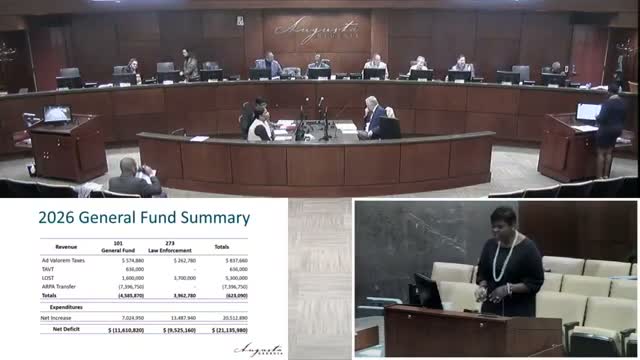
Summary
Commissioners debated a $6.88 million sheriff request, proposed millage increases and impacts on courts and jail population. A motion to adopt the budget with a 1-mill increase failed; commissioners approved deeper NGO cuts but left the broader budget unresolved, reconvening Dec. 16.
Augusta-Richmond County commissioners spent most of their Dec. 2 reconvened meeting wrestling with how to close a multi‑million dollar gap in the proposed FY2026 budget, centered on a reduced but still sizable request from the sheriff’s office and disputed proposals to raise property tax rates.
Administrator Dan Allen told the commission the sheriff’s original $13.4 million ask had been pared to $6,879,280 through negotiated concessions, but that remaining increase — driven largely by higher inmate medical costs, rising employee health insurance and the need to fill positions — is still significant. To make the budget balance, staff recommended a set of across‑the‑board reductions and a possible 0.85–to‑1.0 mill tax increase to fund the law‑enforcement line items.
Several commissioners pressed for detail about the timing and permanence of a millage change. Allen said any millage vote must be included in the budget projection now but the formal millage adoption and roll‑back hearing occur in the statutory August process; revenue from a new millage would appear in the 2026 tax bills when bills are due next year.
Sheriff's Office leaders, including Chief Blanchard, answered detailed questions on staffing, contracts and inmate health expenses. Blanchard said many cost drivers are outside his office’s control — citing rising health costs for inmates, higher county employee insurance and past staffing levels — and that prior reductions had already removed hundreds of positions. The sheriff argued the remaining request represented bare operational needs.
Judicial and prosecutorial leaders warned commissioners that increases in arrests and citations have produced a cascade of demand across the courts. District Attorney Jarrett Williams, judges and the public‑defender office described persistent backlogs, long competency restoration waits and the need for additional prosecutor and defense positions to prevent case processing delays. Public defenders and state and superior court judges said across‑the‑board departmental cuts (for example a 3% reduction) would disproportionately affect public‑safety functions and could undermine the county’s ability to process cases promptly.
Several budget motions failed. A proposal by Commissioner Brandon Garrett to adopt the proposed budget with a 1‑mill increase — which staff said would have left a roughly $936,560 margin if all recommended reductions were enacted — was defeated in a roll‑call vote. The body did approve an amendment to eliminate many discretionary NGO line items (a package of reductions that staff estimated would save roughly $998,270), but the larger balance between law‑enforcement needs, court operations and community services remained unresolved.
Faced with repeated deadlocks over revenue and cuts, commissioners explored more extreme personnel measures as an alternative to higher taxes. Mayor Pro Tem Wayne Guilfoyle proposed large furloughs and position eliminations to reach the gap; staff and legal counsel cautioned about statutory limits on altering constitutional officers’ staffing and the operational impacts of widespread layoffs or furloughs. Administrators warned a furlough of several days could save only a portion of the gap and that RIFs (reductions in force) to match the needed savings would affect roughly a hundred positions or more, depending on salary mix.
The meeting ended without final budget adoption. The commission recessed and scheduled follow‑up budget work for Dec. 9 and a continuation session for Dec. 16 at 9:00 a.m. Staff were directed to return with more precise figures on the fiscal effects of the remaining options, including the personnel and furlough scenarios and the detail behind the revised NGO package.
What’s next: commissioners will reconvene Dec. 16 to continue the budget process. The county must adopt a balanced FY2026 budget before other business proceeds; until then, no final appropriations or policy decisions tied to the budget can be completed.
Quotes (selected): "This is how we got where we currently stand," Administrator Dan Allen said, summarizing the cuts and revenue choices they had discussed.
"We've done everything we can but if we cut any more in prisoner costs, we're just gonna end up with lawsuits," Chief Blanchard said, listing health care, staffing and contract drivers behind the sheriff’s request.
"You can't try your way out of this backlog," District Attorney Jarrett Williams said of trial capacity and the need for earlier case resolution to reduce jail population.
Ending: The commission did not adopt the FY2026 budget and recessed the budget reconvened meeting to Dec. 16 at 9:00 a.m. for additional votes and staff follow‑up.