Get Full Government Meeting Transcripts, Videos, & Alerts Forever!
Get email alerts on the Specific Plans Review topic
No spam. Unsubscribe anytime.
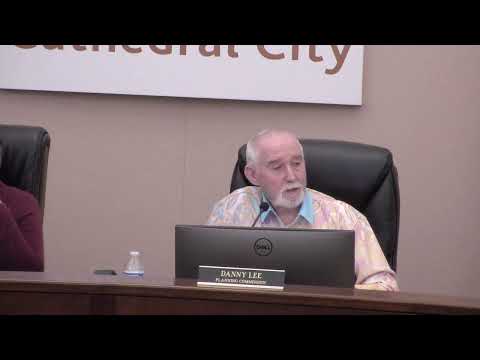
Cathedral City planners begin review of 34 specific plans, flag some for rescission or code consolidation
Summary
Planning staff presented a four-category approach to assess 34 specific plans citywide, identifying older, impractical plans that could be repealed, standards that could be absorbed into the updated development code, and several corridor-level plans needing deeper discussion (notably Date/Deep Palm Drive).
Cathedral City planning staff on Dec. 3 outlined a four-category review of the city—9s 34 specific plans, recommending that some older plans be rescinded, some standards be folded into a citywide development code, and a handful be kept for further study, particularly along the Date (Deep Palm Drive) corridor.
Planning staff described the categories during the planning commission meeting and urged commissioners to confirm the approach before staff returns with recommendations and public hearings. "Rescission of a specific plan or rescinding a specific plan is done in the same manner as adopting it," Planning staff (Speaker 3) said, noting repeals would follow public hearings and either an ordinance or resolution depending on how a plan was adopted.
Why it matters: The report found many specific plans date to the 1980s and 1990s; commissioners said that historical pattern appears to have left a patchwork of small, geographically separated plans whose routine standards (landscape and building setbacks, screening, alley/shared-access requirements) could be incorporated into a unified development code.
Commissioner (Speaker 2) praised the analysis as "really interesting and very thorough," saying the attachments showed roughly 37 plans with about 30 enacted in the 1980s and 1990s and asking whether older, smaller plans should be prioritized for repeal. Staff (Speaker 3) responded that specific plans can originate either as city-led initiatives or developer-led proposals and pointed to SP10014 in the attachments, which noted limited regulatory reach of the existing zoning ordinance when that plan was prepared.
Several commissioners offered examples on how to treat retained plans. Speaker 5 said Rio Vista remains an outcome the commission would want to keep, calling it an example of a plan that yielded a coherent, award-winning development. By contrast, Speaker 4 asked why later development along Date Palm/Ramon sometimes appears inconsistent with the older specific plans and asked staff to research why implementation diverged from plan goals.
Corridor-level discussion: Commissioners and staff agreed that several adjacent specific plans along Date/Deep Palm Drive may be better handled through a corridor-level strategy. Commissioner (Speaker 7) proposed combining updated zoning-code standards with targeted specific-plan layers to create a cohesive corridor vision; staff said Cal Poly San Luis Obispo's design studio is already studying the corridor and could supply complementary ideas.
Public access and transparency: Commissioners urged staff to publish specific plans online and consider a GIS layer so residents can review plan text and standards. "We can simply do as far as making them available to the public on our website," staff (Speaker 3) said.
What happens next: Staff said it will categorize each specific plan, return to the commission with analysis and recommended actions (rescind, retain with amendment, or absorb into the code), and proceed to public hearings if changes are proposed. The commission set no formal votes on Dec. 3 and scheduled future meetings to continue the work; the meeting was adjourned by the chair.
Sources: Planning staff presentation and commission discussion at the Cathedral City Planning Commission meeting, Dec. 3, 2025.