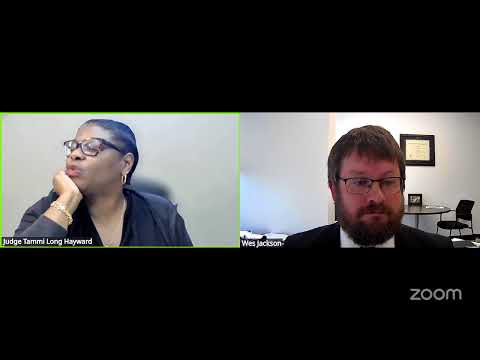
Plaintiff urges judge to force Navistar to produce internal crash-investigation files in Alexander burn case
Loading...
Summary
At a Dec. 3 hearing in Clayton County State Court, plaintiff counsel argued Navistar is withholding critical internal ‘Team Connect’ and product-integrity group files related to multiple tractor-trailer fires; Navistar responded that plaintiffs already have incident reports and that broader production would be unduly burdensome; Judge Tammy Long Hayward said she will issue an order after review.
DESMOND ALEXANDER v. DALTON and NAVISTAR — Dec. 3, 2025 — Clayton County State Court, Judge Tammy Long Hayward presiding.
Plaintiff counsel Drew Ashby told the court that Navistar’s internal investigative files and field reports are “the lynchpin” of a products-liability case over a tractor-trailer crash that left the plaintiff catastrophically burned. Ashby said Navistar keeps an internal database called Team Connect and a product-integrity group (PIG) that creates field reports and engineer notes for almost every crash notice; those files, he argued, “exist nowhere else in the world” and are necessary to prove notice, design defects, and punitive damages (plaintiff opening, summarized from hearing).
“Navistar creates these internal files for every notice of a crash,” Ashby said. “We’ve asked for these, and Navistar refuses.” He told the judge plaintiffs narrowed their requests to collisions and fires involving trucks with fuel tanks mounted outside the frame rails, and asked for a targeted query of Team Connect, specified field reports, and non-privileged PIG files. Ashby warned that without those documents Navistar will argue plaintiffs cannot prove substantial similarity, move to exclude experts, or win summary judgment (plaintiff argument).
Navistar counsel Richard North replied that plaintiffs already received the claims and incident reports that were the subject of similar discovery in prior cases, that courts in other jurisdictions limited productions to claims or written reports, and that the defendants are willing to supplement prior productions. North said producing the broader set of non-privileged documents plaintiffs seek — including depositions, expert reports and internal emails stored across decades — would impose a heavy burden of privilege review for many case files. He also cited prior rulings in related litigation that allowed plaintiffs access to claim reports but not the “whole kitchen sink” of litigation files (defense argument).
The parties debated whether PIG files are segregated from the law department and thus non-privileged, and whether Navistar’s searches and prior productions are sufficient. Ashby said the presence or absence of a PIG file is itself evidence: if the file is empty, that tends to show the company did not investigate; if it has material, plaintiffs need to see it. North countered that his clients have complied with prior orders and will continue to supplement responses; he objected to the breadth of plaintiffs’ requests and emphasized the time and burden to process decades of files.
Judge Hayward heard both sides and said she would issue a written order. No dispositive ruling was entered from the bench at the hearing; the court indicated it will evaluate the motion and related briefing before directing production or setting limits on scope and procedures.
Why it matters: Plaintiffs contend Navistar’s internal files will show the company knew for years of a fuel-tank configuration that can be punctured in frontal-offset crashes and cause catastrophic, fuel-fed fires. The defense says the plaintiffs already have notice evidence and that unlimited access to decades of internal materials is disproportionate. The judge’s forthcoming order will determine how much internal investigative material reaches plaintiffs and could shape whether the case proceeds to expert testimony or dispositive motions.
Next steps: Judge Hayward said she will issue an order after reviewing the submissions and arguments made at the Dec. 3 hearing. If the court orders the files produced, the parties will need to agree on privilege-logging and timing; if the court limits production, plaintiffs may seek further relief on appeal or in other forums.
Speakers (first appearance listed): - Judge Tammy Long Hayward — presiding judge (first at SEG 005) - Drew Ashby — plaintiff counsel (first at SEG 011) - Chris Stuckey — plaintiff co-counsel/monitoring (first at SEG 015) - Richard North — Navistar counsel, Nelson Mullins (first at SEG 1992) - Rocky McNeil — counsel appearing in earlier matters; observed (first at SEG 018)
Authorities referenced: Harrison v. McPhee (Georgia appellate citation mentioned by counsel), cited state-case authorities on summary judgment and discovery practice; prior discovery orders from related cases in Gwinnett County and North Carolina were discussed by defense counsel. Specific citations were drawn from oral argument and briefs on file.
Provenance: topic introduced SEG 1121; plaintiff presentation ends SEG 1989; defense response spans SEG 1992–2334; plaintiff rebuttal and close in SEG 2345–2530.
Topics and newsroom tags: product liability; discovery; Navistar; tractor-trailer fires; Team Connect; PIG; punitive damages.