Get Full Government Meeting Transcripts, Videos, & Alerts Forever!
Get email alerts on the Home Occupation Standards topic
No spam. Unsubscribe anytime.
Lake Oswego planning commission recommends adjusted home-occupation rules, calls urban agriculture a conditional use
Summary
After public testimony and lengthy deliberation, the Lake Oswego Planning Commission voted 4–1 to forward modified development-code changes (LU25-0002) to city council: it struck three proposed restrictions, chose a limited-outdoor-activity option, and directed that urban agriculture be handled as a conditional use with site-specific client limits.
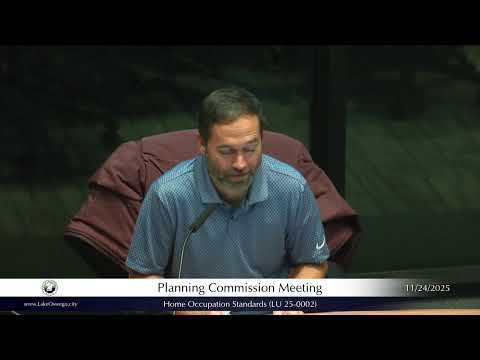
The Lake Oswego Planning Commission on Nov. 24 voted to forward a recommendation to city council on proposed changes to the city’s home-occupation rules (LU25-0002), but commissioners altered parts of staff’s draft and asked for site-level review of an urban-agriculture use. The preliminary recommendation passed 4–1.
Staff coordinator Michael McNamee walked the commission through the draft text amendment, which would replace a vague ‘‘residential character’’ standard with clearer, objective standards; classify home occupations as types A (no customers on-site), B (customers on-site) and C (short-term rentals); cap hazardous substances at ‘‘consumer quantities’’ consistent with ORS chapter 453; limit marked commercial vehicles parked off-site to one within 300 feet; and create a new urban-agriculture use permitted in R10 and R15 zones on lots larger than one acre. Staff recommended approval and noted the item would return with findings for the commission on Dec. 8 and, tentatively, go to city council on Jan. 20, 2026. McNamee said staff’s proposal was informed by prior work sessions and a survey sent to licensed home-occupation owners.
The presentation also described two options for outdoor activity tied to type-B businesses. Option 1 would allow limited instructional outdoor classes (for example, sessions capped at six people, two sessions per day, up to six weekly, hours 9 a.m.–7 p.m., and not on Sundays or holidays); Option 2 would ban outdoor activity — the approach staff and policy had effectively used previously. McNamee summarized written testimony from an existing winery asking for a higher client cap for urban agriculture and recommended the commission forward the amendments to council with any adjustments the commission deemed appropriate.
During public comment, resident Diane Cassidy of the Blue Heron neighborhood said she was surprised to learn about a separate Cruiseway map-amendment hearing only after it had occurred and urged greater citizen involvement, saying the change could be citywide in consequence. Business owner Sam Hall described practical impacts on home-based entrepreneurs, saying limits risk constraining small businesses and raising enforcement questions about terms such as ‘‘marked commercial vehicle.’' Bill Youngblood, senior code enforcement specialist, told commissioners the proposed numeric limits are intended to give staff a clear standard for enforcement and that complaints about outdoor activities and neighborhood impacts motivated the draft changes.
Commission discussion focused on avoiding unintended consequences while creating rules that are enforceable. Several commissioners said they supported clearer standards and the three-tier classification but were uneasy with particular numeric caps that could limit longstanding or unique businesses. Commissioners debated whether local hazardous-substances limits would add value beyond state and fire-department controls, whether the off-site marked-vehicle rule was addressing an actual demonstrated problem, and whether outdoor activities should be allowed in limited form or remain banned by policy.
To resolve differences, one commissioner moved to forward the staff recommendation to council but strike subsections 3, 5 and 6 of the draft (removing the proposed local hazardous-substance limit and two other numbered restrictions), adopt Option 7a (the limited-outdoor-activity approach) for type-B businesses, and treat the urban-agriculture use as a conditional use so that the maximum number of clients could be set through a discretionary conditional-use permit based on site-specific evidence. The motion passed, constituting a tentative decision; the city attorney stated the decision is preliminary pending adoption of a written order and findings at the commission’s December meeting.
The commission’s recommendation does not itself change the code. Staff will prepare written findings for the commission on Dec. 8; if the commission finalizes those findings the recommendation would then be forwarded to city council for consideration at a future hearing.
Votes at a glance: Motion to forward LU25-0002 with modifications (strike subsections 3, 5 and 6; adopt Option 7a; urban agriculture as conditional use) — Preliminary recommendation passed 4–1.
Next steps: The commission will consider and adopt written findings at its Dec. 8 meeting; the amended code would then be scheduled for a city-council hearing (tentatively Jan. 20, 2026).