Get Full Government Meeting Transcripts, Videos, & Alerts Forever!
Get email alerts on the Live Local Act topic
No spam. Unsubscribe anytime.
Committee questions whether Live Local Act parking and AMI rules fit Walton County’s coastal and rural context
Summary
Committee members and public commenters raised concerns that Live Local Act language — including an allowance to count 'available parking within 600 feet' and AMI references at 120% (and in some areas 140%) — is designed for metropolitan settings and may not be workable for Walton County without additional analysis or local adaptation.
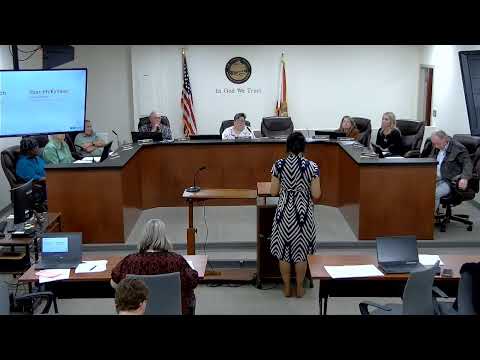
Members of Walton County’s Affordable Housing Advisory Committee reviewed a one-page handout summarizing Live Local Act changes and questioned several provisions’ fit for a county with limited public parking and a mix of coastal and rural areas.
Donna, presenting materials on behalf of an absent presenter, said a provision allowing developers to rely on "available parking within 600 feet" is typically aimed at metropolitan, walkable areas and is "very difficult" to apply in Walton County because public parking is limited. She said that if a developer wanted to rely on nearby public parking, the developer would need a parking study proving there is sufficient capacity for both existing uses and residential overflow.
During public comment, Barbara Murano said AMI thresholds at 120% (and cited examples of 140% in some areas) would not reach the people the committee aims to help: "We know that that's not gonna touch the people we wanna touch," she said. Staff responded that local governments cannot change the state statute and that, absent factual evidence, it is difficult to deny developers relying on the statute’s thresholds.
Committee members recommended the county integrate local transit and parking data into any interpretation of Live Local provisions and to consider where strategies (for example, mixed-use placemaking or transfer-of-development-rights tools) could make rural-affordable housing feasible near major roads or transit.
What’s next: Committee members asked staff to reflect these concerns in the committee’s annual report and to continue discussion in future meetings.